The Caravan Database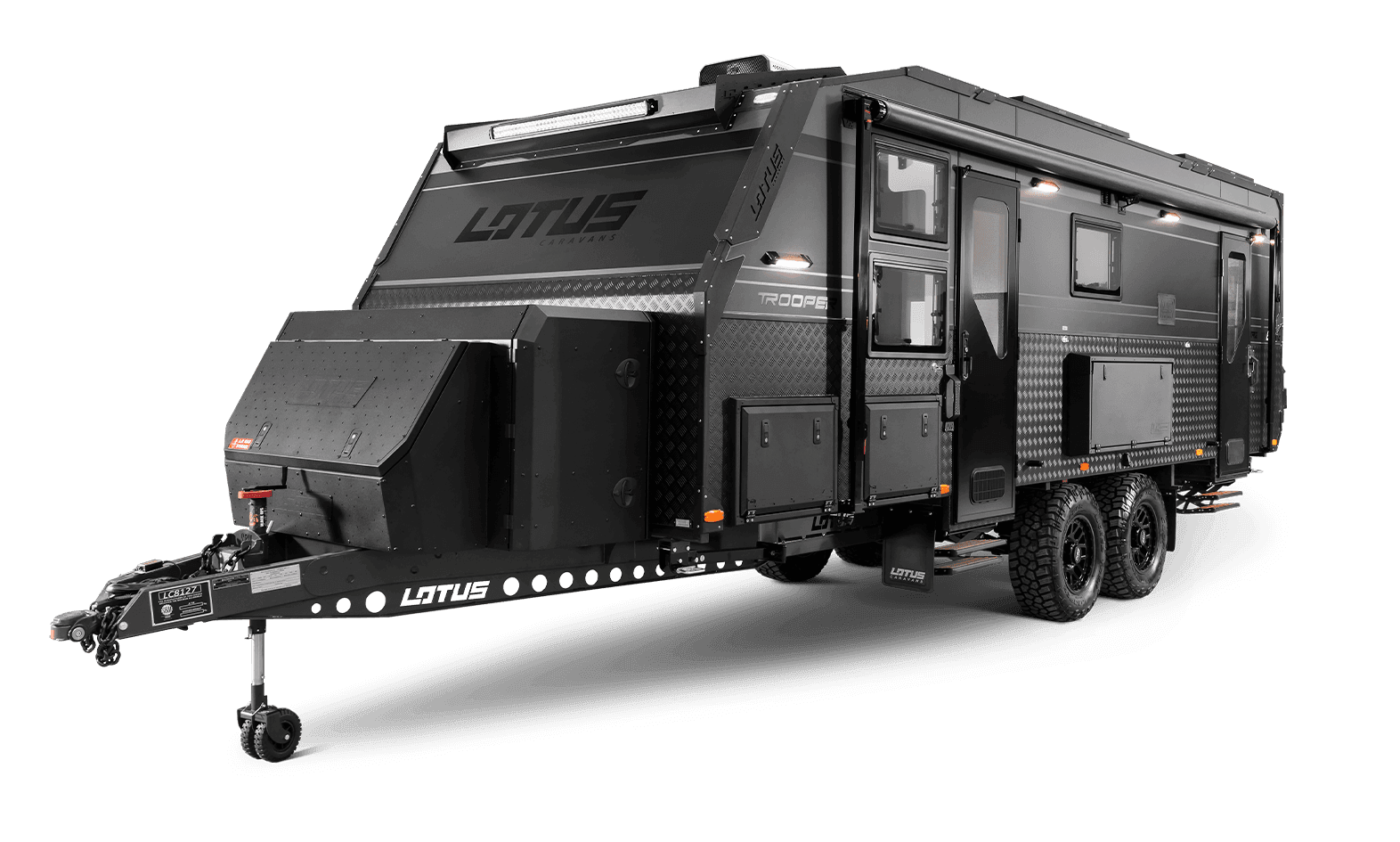
The 5 Best Off-Road Caravans in Australia for 2026
Australia has some of the best caravan destinations on earth — and the worst roads to reach them. If you're serious about getting beyond the bitumen, the best off-road caravans in Australia aren't chosen by looking at brochures. They're chosen by understanding what happens when 800 kilometres of corrugated outback track separates you from the nearest town.
This guide cuts the market down to five genuine picks, selected on build quality, real-world performance, and who each van actually suits — with honest pros and cons for each.
What Actually Makes an Off-Road Caravan
"Off-road" in Australian marketing means almost nothing without examining the components. Checkerplate cladding and chunky tyres don't make a van capable. What matters is:
- Independent suspension — coil or airbag, not leaf springs
- Articulating coupling — DO35 or similar, allowing independent movement between van and tow vehicle
- Hot-dipped galvanised chassis — not just painted steel
- High ground clearance and departure angle — so the rear doesn't scrape on dips and creek crossings
- Off-grid systems substantial enough for extended remote stays
With that filter applied, here are the five vans that genuinely deliver.
1. Lotus Trooper — The Benchmark All-Rounder
Best for: Couples and families who want a proven, customisable van they can confidently take anywhere short of the most extreme 4WD tracks.
Visit the Lotus Trooper page on the Lotus Caravans website →
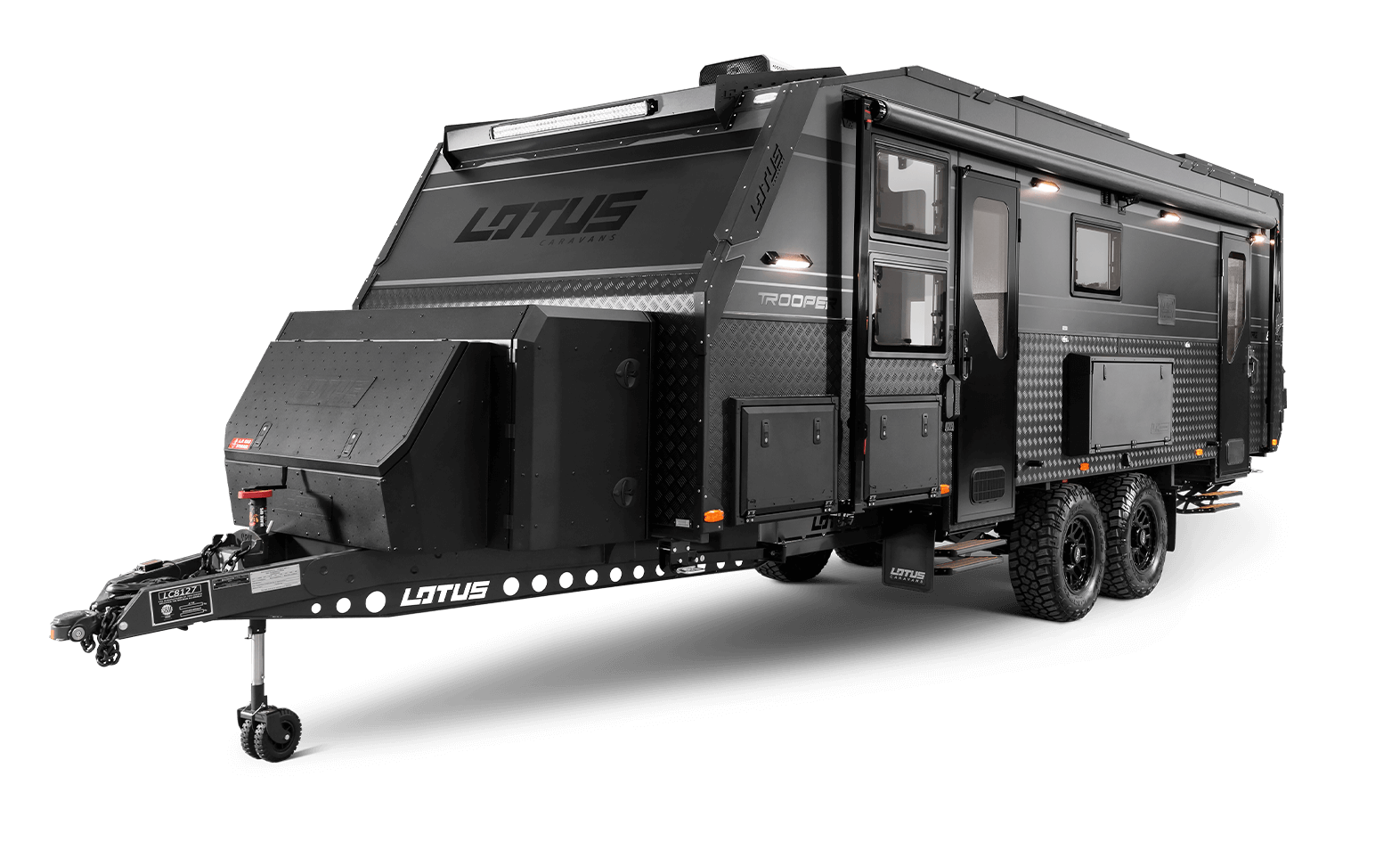
The Lotus Trooper is one of Australia's most popular off-road caravans, with a reputation built on owner reports from the Birdsville Track, the Gibb River Road, and the Savannah Way. After a rough run to Leigh Creek and the back tracks to Yunta in a 2026 Trooper, one verified owner reported on ProductReview.com.au:
"The structure remained sound and even glassware in the cupboards stayed intact."
For 2026, the Trooper has been completely re-engineered around a new S&M Chassis A-frame design with a drop-gooseneck for easier hitching. The suspension is Cruisemaster XT Air with a full Body Control System — the best airbag suspension currently available on an Australian production caravan. Electrically, the base Trooper runs on 400Ah REDARC lithium batteries, 850W of solar, and a 3,000W inverter, which is enough to run air conditioning off-grid.
The Dometic Dust Reduction System is standard — it actively pumps filtered air into the cabin, pressurising the interior so dust can't infiltrate. If you've spent a week behind a 4WD on an outback track, you understand what that's worth.
What sets the Trooper apart from everything else in this list is breadth of choice: 20 ergonomically designed floor plans from 18'9" to 24'6", covering couples, families, singles, and remote workers. Every van is custom-built to order in Australia.
Pros:
- 10+ years of documented outback performance
- 20 floor plans — the most versatile off-road range in Australia
- Cruisemaster XT Air Suspension with BCS — best-in-class
- Dust reduction system as standard
- Full aluminium AL+ frame construction
Cons:
- Larger models have an ATM of 3,500–4,500kg — may require upgrading your tow vehicle significantly
- Premium pricing: from ~$85,000 to well into six figures for the TRX and Platinum variants
- Not suited to the most extreme tracks (Old Telegraph Track, major sand dune crossings)
Key specs (base Trooper):
- Length: 18'9"–24'6"
- Suspension: Cruisemaster XT Air with BCS
- Battery: 400Ah REDARC lithium | Solar: 850W | Inverter: 3,000W
- Price: From ~$85,000
If your tow vehicle is on the lighter side, also consider the Lotus Off Grid — same suspension and build quality in a lighter package (7 layouts from 17'9" to 21').
2. Offline Campers Solitaire 14 — The Compact Specialist
Best for: Couples who want to go further on rougher tracks without needing a truck to tow.
Visit the Solitaire page on the Offline Campers website →
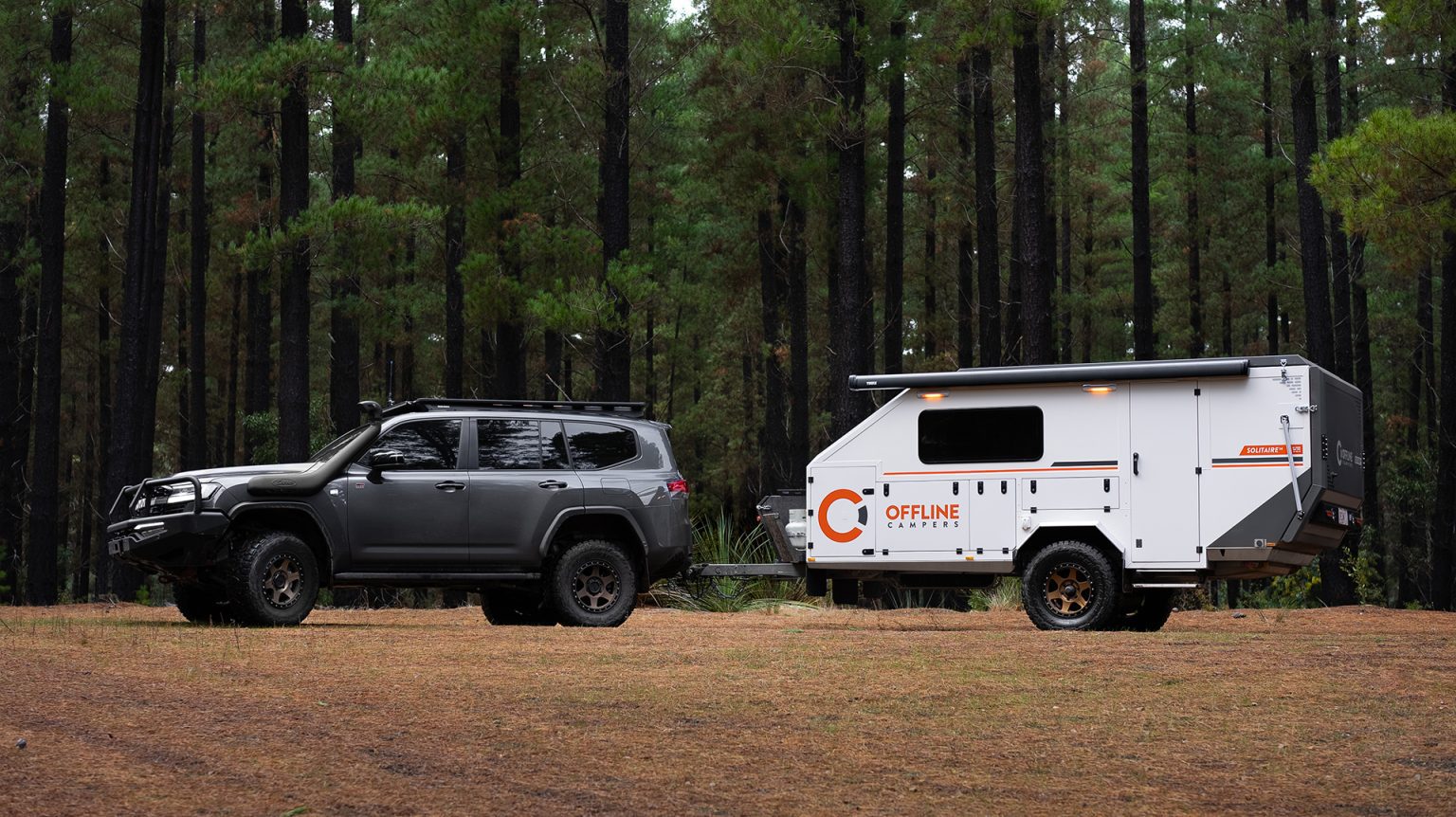
Offline Campers builds in Adelaide, and the Solitaire 14 is its answer for travellers who want caravan comforts in a camper-sized package. It's a fundamentally different proposition to the Trooper — smaller, lighter, and built around the philosophy that the best off-road caravan is the one that can actually follow your 4WD where you want to go.
The Solitaire 14 weighs just 1,600kg tare with an ATM of 2,499kg — making it one of the few genuine off-road vans you can legally tow with a Prado or similar mid-size 4WD, with close to 900kg of payload left over. That alone opens up tracks that are simply inaccessible to heavier vans.
Light doesn't mean fragile here. The Solitaire sits on a steel chassis that Offline engineers and hot-dip galvanises in house, under an aluminium body, with Cruisemaster ATX air suspension and an onboard compressor as standard. The chassis and suspension carry a five-year warranty. At 1.8m wide it is narrower than almost any full caravan, which matters on overgrown tracks.
The catch: this van is built around outdoor living. The main kitchen is external — a stainless steel unit that folds out from the side — backed by a small internal kitchen for bad weather. The interior has a queen bed and an ensuite, but it is compact. You're not buying this for a large living space. You're buying it because it will follow your 4WD into places a larger van cannot go.
Pros:
- 1,600kg tare — genuinely Prado-towable
- In-house galvanised steel chassis with a five-year chassis and suspension warranty
- Cruisemaster ATX air suspension with onboard compressor
- 210L of fresh water, a 200Ah lithium battery and 350W of roof solar as standard
- Internal ensuite in a 1.8m-wide body
Cons:
- Main kitchen is external — you'll mostly be cooking outside
- Compact interior designed for 2, not families
- Priced well above larger conventional off-road vans
- A hybrid, with more set-up than a full caravan
Key specs:
- Towing length: 6,100mm | Body width: 1,800mm
- Tare: 1,600kg | ATM: 2,499kg
- Suspension: Cruisemaster ATX air
- Price: $138,600
View full specs for the Solitaire 14
3. Trakmaster Explorer — The Compact Outback Specialist
Best for: Couples who want a compact, purpose-built off-road hybrid from one of Australia's most respected outback brands — now built by Track Trailer.
Visit the Trakmaster Explorer page on the Trakmaster website →
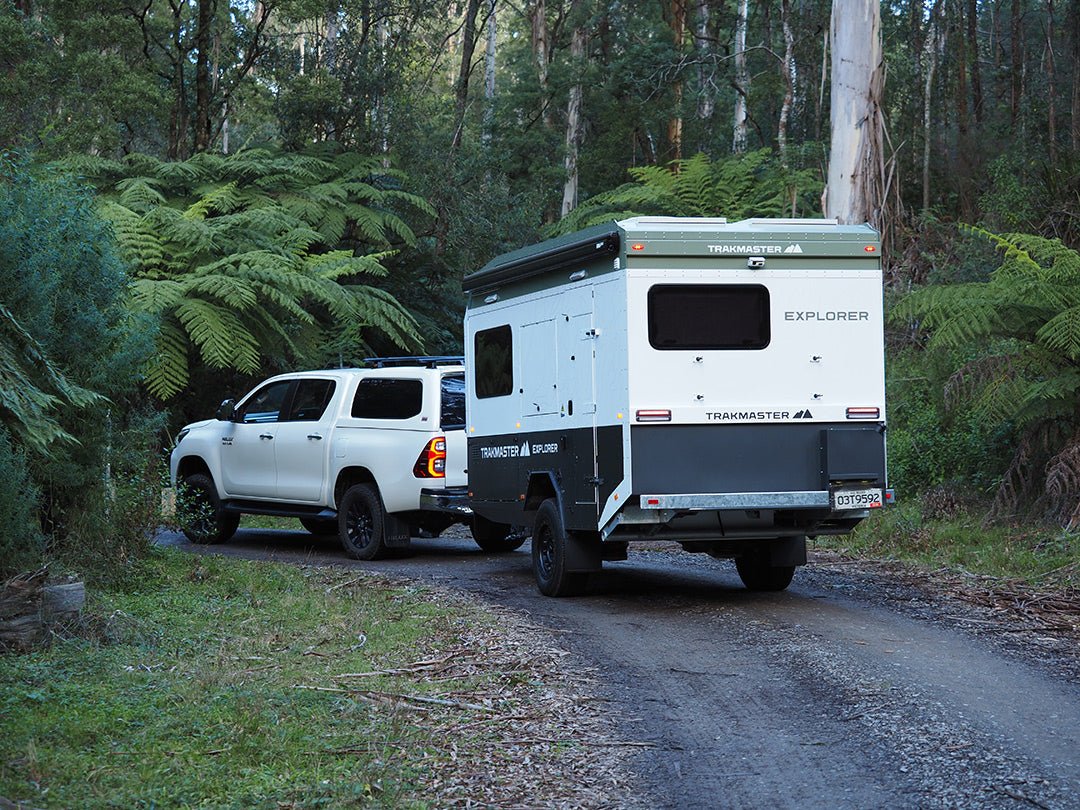
Trakmaster was founded in Melbourne in 1995 by Russell Seebach, who built the brand around a single principle: caravans should survive continuous remote-area travel, not just occasional dirt roads. After changing hands twice — first to Gason Industries in 2016, then to Track Trailer in 2020 — the brand has been relaunched with the Explorer, a compact 14ft full-height hybrid that blends Trakmaster's outback philosophy with Track Trailer's proven camper engineering.
As Caravan World noted in their review of the Explorer:
"The Explorer will suit couples looking for a high-end option that's built tough and shows superb attention to detail."
What Makes It Different
The Explorer is a 14ft single-axle full-height hybrid — compact by design, not by compromise. The ladder-style chassis is built in-house from Australian steel and hot-dip galvanised. Suspension is Trakmaster's own Trak-Two independent trailing arm coil system with twin upright shock absorbers per side, custom-tuned specifically for the Explorer's ride characteristics, paired with a Cruisemaster DO-35 coupling and Dexter Sway Control.
The body uses a frameless construction method evolved from Track Trailer's camper manufacturing process — individual powder-coated sheet metal panels bonded over closed-cell foam, secured with internal fixings and an external skeletal frame. At just 2.0m wide and 6.3m overall length, the Explorer is roughly 400mm narrower than most full-size caravans, making tight tracks and secluded campsites significantly more accessible.
Off-grid power is serious for a van this size: twin 250Ah Revolution lithium batteries (500Ah total), 400W of rooftop solar, a 2,000W inverter, and REDARC Manager 30 and Redvision battery management. Webasto rooftop air conditioning and diesel heating are standard. Three bed configurations are available — north-south queen, east-west queen, or twin singles — and the rear combination ensuite includes a Dometic cassette toilet.
Pros:
- 2,060kg tare — genuinely Prado-towable
- Hot-dip galvanised chassis built in-house from Australian steel
- Trak-Two independent coil suspension, tuned specifically for the Explorer
- 500Ah lithium and 400W solar — serious off-grid capability for a compact van
- Track Trailer engineering pedigree combined with Trakmaster outback DNA
Cons:
- 14ft body — comfortable for couples, not suited to families
- Premium pricing for a compact van at ~$149,770
- New model under new ownership — limited long-term track record for this specific build
- 50L grey water capacity is modest for extended remote stays
Key specs (Trakmaster Explorer):
- Overall length: 6.3m | Width: 2.0m | Height: 3.0m
- Tare: 2,060kg | ATM: 2,600kg | Ball weight: 175kg
- Suspension: Trakmaster Trak-Two independent coil | Coupling: DO35
- Battery: 500Ah lithium | Solar: 400W | Inverter: 2,000W
- Price: From ~$149,770
4. Kokoda XCore — The Family Off-Roader
Best for: Families who need off-road capability, genuine build quality, and enough space that travelling with kids doesn't feel like a puzzle.
Visit the Kokoda Caravans website →
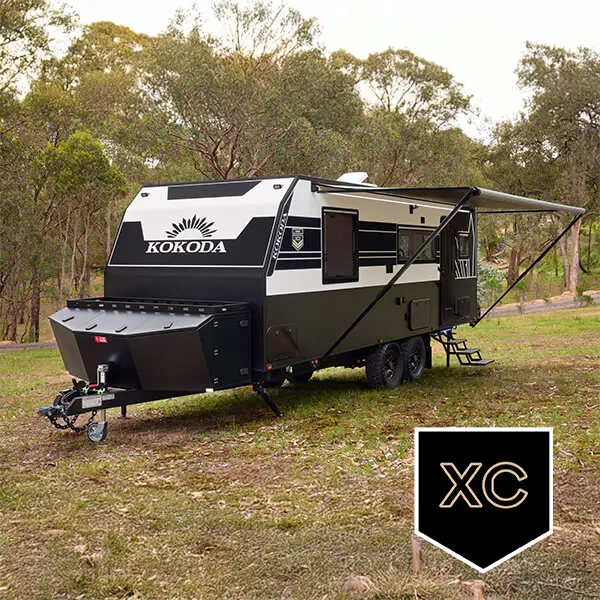
Kokoda Caravans has been through a significant transformation since the Price family took ownership in 2019. The critical change: they brought manufacturing in-house. Previously, the brand outsourced builds to contract manufacturers — with the quality control variability that inevitably brings. Today, they've invested in CNC machinery that cuts panels, cabinetry, and walls to millimetre precision.
Why the Construction Matters
The XCore range uses XPS foam-cored sandwich panels with fibreglass skins — these won't rot, have excellent thermal properties, and are structurally more consistent than traditional timber frames. More importantly, as Caravan World reviewed, the CNC-cut cabinetry interlocks directly into the wall panels, so the cupboards and internal walls add rigidity to the entire caravan body — not just sit inside it. On corrugated roads, this matters. Poorly-built vans develop rattles, creaks, and fatigue cracks within months. The XCore construction resists this.
Kokoda backs their work with a 3-year factory warranty — more generous than most competitors in this segment. The XCore family range (including the MIA and Platoon models) provides the layouts families genuinely need: dedicated bunk areas, separate adult spaces, and practical kitchens. The brand has won multiple industry awards, including Most Innovative and Most X-Factor at Caravan of the Year 2025 for their Counterstrike Vincere flagship.
Pros:
- CNC manufacturing reduces build variation common in hand-built vans
- XCore panels: rot-proof, thermally superior, structurally rigid
- Cabinetry interlocked into walls adds whole-body rigidity
- Family floor plans that make sense for kids
- 3-year factory warranty
Cons:
- Pre-2019 secondhand models were contract-built — inspect carefully before buying used
- Family-sized builds are heavier — requires a capable tow vehicle
- In-house manufacturing transition still ongoing; some models still built off-site
Key specs (MIA XCore — guide only):
- Construction: XCore XPS foam-cored fibreglass sandwich panels
- Chassis: Hot-dipped DuraGal steel
- Coupling: DO35
- Warranty: 3 years factory
- Price: From ~$99,990
5. Mountain Trail RV LXV Paragon — Buy Once, Buy Right
Best for: Buyers with a $150,000+ budget who want uncompromised off-road performance and the best resale value in the segment.
Visit the Mountain Trail RV Paragon page on the MTRV website →
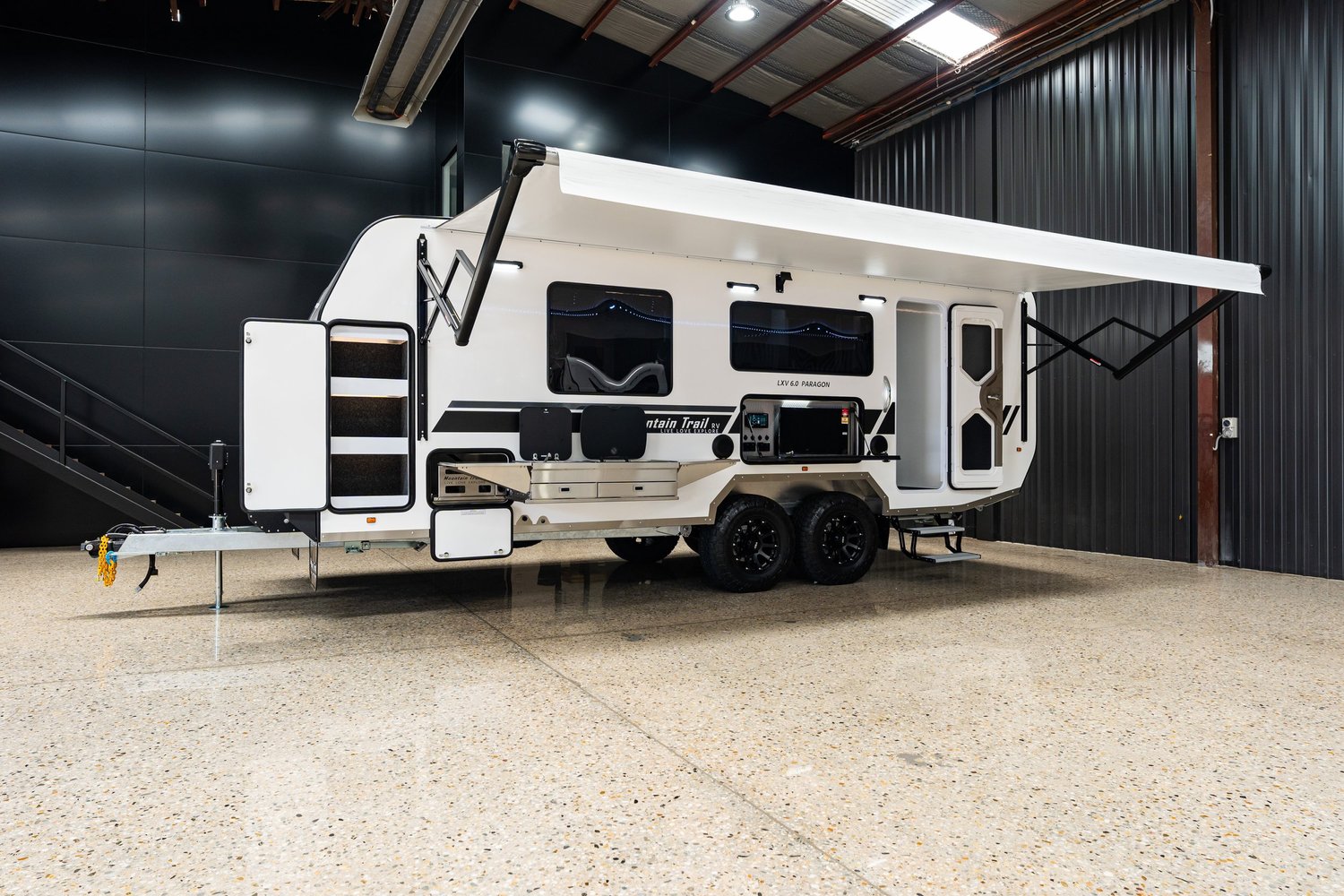
Mountain Trail RV operates out of Albury, NSW, and has been manufacturing their own suspension systems in-house since 2009 — a detail that separates them from almost every other caravan builder in Australia. The LXV Paragon range is the result of 19 years of refinement and represents the clearest case in the market for spending more upfront and spending less over time.
What You're Actually Paying For
The MTRV chassis is welded on-site from Australian steel and hot-dip galvanised. The independent trailing arm airbag suspension offers three pre-programmed ride heights and a self-levelling program — the van automatically keeps itself level regardless of load or terrain. In practical terms, you arrive at an uneven campsite in fading light and the van sorts itself out.
The cabinetry is built from CNC-pressed aluminium — no timber, no screws, no glue. Timber cabinetry fatigues on corrugations: it warps, rattles, and eventually fails. Aluminium doesn't. Owner accounts are consistently strong. One LXV 6.2 owner who had completed the Simpson Desert, Cape York, Cape Arnhem, and the NSW and Victorian high country wrote on ProductReview.com.au:
"Not one speck of dust or water has entered and surprisingly the van has handled the rough and corrugated roads without any interior or exterior damage or deterioration."
The resale value evidence is compelling. As RV Daily reported, LXV 6.7 models originally purchased for ~$170,000 in 2020 were selling secondhand in 2025 for more than their original price. In a market where caravans typically depreciate steeply, that's extraordinary.
Pros:
- In-house suspension with self-levelling — best system in the market
- CNC aluminium cabinetry: won't fatigue or rattle on corrugations
- Full manufacturer's off-road guarantee
- Resale value that holds — 2020 LXV 6.7s selling above original purchase price in 2025
- Owner-documented performance in the Simpson Desert, Cape York, and Karijini
Cons:
- Price: LXV Paragon starts ~$150,000; LXV 6.7 from ~$224,990
- Large models (3,500kg ATM) require a LandCruiser 300, Ram 1500, or similar at minimum
- Small manufacturer in Albury — less accessible service network nationally
- Some reported customer service inconsistency and build delays
Key specs (LXV Paragon):
- Suspension: MTRV in-house trailing arm airbag, 3 ride heights, self-levelling
- Battery: 600Ah lithium | Solar: 1,075W | Inverter: 3,000W
- Chassis: Hot-dipped galvanised Australian steel, welded in-house
- ATM: Up to 3,500kg
- Price: From ~$150,000+
Towing Compatibility: The Mistake Most Buyers Make
Before any of the above is relevant, confirm your tow vehicle can legally pull your chosen van. It's not just about towing capacity — it's Gross Combination Mass (GCM): the maximum legal weight of your fully loaded vehicle plus your fully loaded caravan combined.
Every 4WD has a GCM limit. A LandCruiser rated to tow 3,500kg can only actually tow around 3,200kg once you account for a realistic loaded vehicle weight of ~2,800–3,000kg. This catches a lot of buyers out.
Rough tow vehicle guide:
- Offline Campers Solitaire 14 (2,499kg ATM): Prado, Fortuner, top-spec dual-cab utes
- Kokoda XCore family (~3,000–3,200kg ATM): LandCruiser 200/300, Ram 1500, large dual-cabs
- Trakmaster Explorer (2,600kg ATM): Prado, Fortuner, top-spec dual-cab utes
- Lotus Trooper (up to 4,500kg ATM on larger models): Ram 1500, F-250, Silverado
- Mountain Trail RV LXV Paragon (3,500kg ATM): LandCruiser 300, Ram 1500, F-250
Work out your GCM before you fall in love with a van — not after you've signed a deposit.
The Bottom Line
The best off-road caravan isn't the one with the most impressive spec sheet — it's the one that matches how you actually travel and what your tow vehicle can genuinely handle.
- Lotus Trooper — Couples or families wanting proven capability and the widest choice of floor plans
- Offline Campers Solitaire 14 — Couples wanting maximum capability in a Prado-towable package
- Trakmaster Explorer — Couples wanting a compact, Track Trailer-built van for serious outback travel
- Kokoda XCore — Families needing space and modern construction
- Mountain Trail RV LXV Paragon — Buyers buying once, buying right, where budget isn't the first question
Browse off-road caravans on The Caravan Database to compare specs and filter by what matters to you, or use our comparison tool to put your shortlist side by side.