The Caravan Database
Caravan Buying Guide for Beginners
Buying your first caravan is one of the most exciting — and overwhelming — purchases you'll make. There are hundreds of models on the market, dealers who'll tell you anything to close a sale, and technical jargon that makes no sense until someone explains it properly. This guide covers what you actually need to know before you spend a dollar.
Types of Caravans — And Which Suits You
Not all caravans are built for the same purpose. Understanding the basic types will immediately narrow your search.
Full-height caravans are the most common type in Australia. They have solid walls, a fixed roof, and permanent living spaces inside. They're comfortable, well-insulated, and suit everything from weekend caravan parks to extended cross-country touring. If you're new to caravanning and plan to stay primarily on sealed roads and established parks, this is where most buyers start.
Pop-top caravans have a roof section that cranks up for full standing height when parked and lowers for travel. The advantage is a significantly lower profile on the road — better fuel economy, easier handling in crosswinds, and they fit in a standard garage. The trade-off is slightly less insulation and headroom around the edges when set up.
Hybrid caravans combine a solid body with fold-out canvas bed sections at one or both ends. They're lighter and more compact than full-height vans while still offering a proper internal living space. Popular with couples who want something between a camper trailer and a full caravan.
Camper trailers fold out from a compact road package into a tent-style setup. They're the lightest and cheapest option, ideal for off-grid camping, but offer less comfort and weather protection than any hard-walled caravan.
Understanding Caravan Weights — The Numbers That Actually Matter
Weight is the single most important technical factor in buying a caravan, and it's where most first-time buyers get caught out. There are four numbers you need to understand:
Tare weight is what the caravan weighs as it leaves the factory — empty, with no water, no gear, no food. Think of it as the caravan standing naked on the scales.
ATM (Aggregate Trailer Mass) is the maximum legal weight of the caravan fully loaded — water tanks full, gear packed, everything you're carrying. This is the number that must not exceed your tow vehicle's towing capacity.
Ball weight (also called tow ball download) is the weight the caravan pushes down on your vehicle's tow ball. It's typically 10–15% of the loaded caravan weight. Your vehicle has a maximum ball weight rating — exceed it and you risk damage to the rear suspension and chassis.
Payload capacity is the difference between tare weight and ATM. This is how much stuff you can actually put in the van. A caravan with a tare of 2,200kg and an ATM of 2,700kg gives you 500kg of payload — which sounds like a lot until you fill the water tanks (100L = 100kg), add bedding, kitchen gear, tools, a generator, and food for two weeks.
Always weigh your caravan loaded at a public weighbridge before your first major trip. You'd be surprised how quickly you'll hit the limit.
Matching Your Tow Vehicle
Your caravan choice starts with your tow vehicle — not the other way around. Every vehicle has three critical ratings:
- Towing capacity — the maximum weight it can legally tow
- GCM (Gross Combination Mass) — the maximum legal weight of your loaded vehicle plus loaded caravan combined
- Tow ball weight limit — the maximum downward force on the hitch
The catch that most buyers miss is GCM. A vehicle rated to tow 3,500kg might have a GCM that only allows 3,000kg once you account for the weight of the vehicle itself with passengers and gear. Always calculate your actual GCM before signing anything.
A rough guide for common Australian tow vehicles:
- SUVs (RAV4, CX-9, Kluger): Small pop-tops and camper trailers up to ~1,800kg ATM
- Mid-size 4WDs (Prado, Fortuner, Everest): Vans up to ~2,500kg ATM
- Full-size 4WDs (LandCruiser 300, Patrol Y62): Vans up to ~3,200kg ATM
- American trucks (Ram 1500, F-250): Large vans up to 4,500kg+ ATM
If you're buying a caravan and a tow vehicle, buy the vehicle first — or at least confirm the one you have can handle the van you want.
New vs Used — What to Consider
Buying new gives you a manufacturer warranty (typically 1–3 years), the ability to customise layouts and options, and the confidence that nothing's been damaged or poorly repaired. The downside is cost and depreciation — a new caravan typically loses a meaningful share of its value in the first couple of years — figures of 20–30% are commonly quoted in the industry, though it varies by brand and market conditions.
Buying used gets you more van for your money and lets someone else absorb the depreciation. A 2–3 year old van in good condition is often the best value in the market.
If you're buying used, inspect carefully:
- Water damage — check for soft spots in walls and floors, musty smells, staining around windows and hatches
- Chassis condition — look for rust, cracks, and signs of impact damage underneath
- Suspension — worn bushings, leaking shocks, uneven tyre wear
- Electrical systems — test every light, outlet, and appliance; check battery health
- Gas system — must have a current gas compliance certificate
- Damp meter — bring one, or insist the seller provides a damp report. Moisture behind walls is invisible until it's catastrophic
Consider an independent pre-purchase inspection by a qualified caravan technician — it typically costs $300–$600 and can save you from a $10,000 mistake.
Setting a Realistic Budget
The sticker price is only the beginning. Factor in these additional costs before you commit:
- Registration and CTP insurance: Varies by state — typically $300–$800 per year
- Comprehensive insurance: $800–$2,500 per year depending on the van's value and where you travel
- Accessories and setup: Tow bar, weight distribution hitch, brake controller, solar panels, annexe — easily $2,000–$5,000 for a new setup
- Servicing: Annual service costs $300–$800; bearings, brakes, and suspension components need regular attention
- Storage: If you can't park at home, off-site storage runs $100–$400 per month depending on location and whether it's covered
As a rough guide for entry-level new caravans in Australia:
- Basic pop-top (single axle): $30,000–$55,000
- Mid-range full-height (tandem axle): $55,000–$90,000
- Off-road capable: $80,000–$150,000+
Used vans in good condition start from around $15,000 for basic older models up to $100,000+ for premium secondhand off-roaders.
How You'll Travel Shapes What You Buy
Think honestly about where you'll actually go — not where you dream of going someday.
Highway and caravan park touring is how the vast majority of Australian caravanning actually happens. If that's your plan, you don't need off-road suspension, heavy-duty protection, or massive off-grid power systems. A well-built road-touring caravan with a good layout and comfortable bed will serve you perfectly.
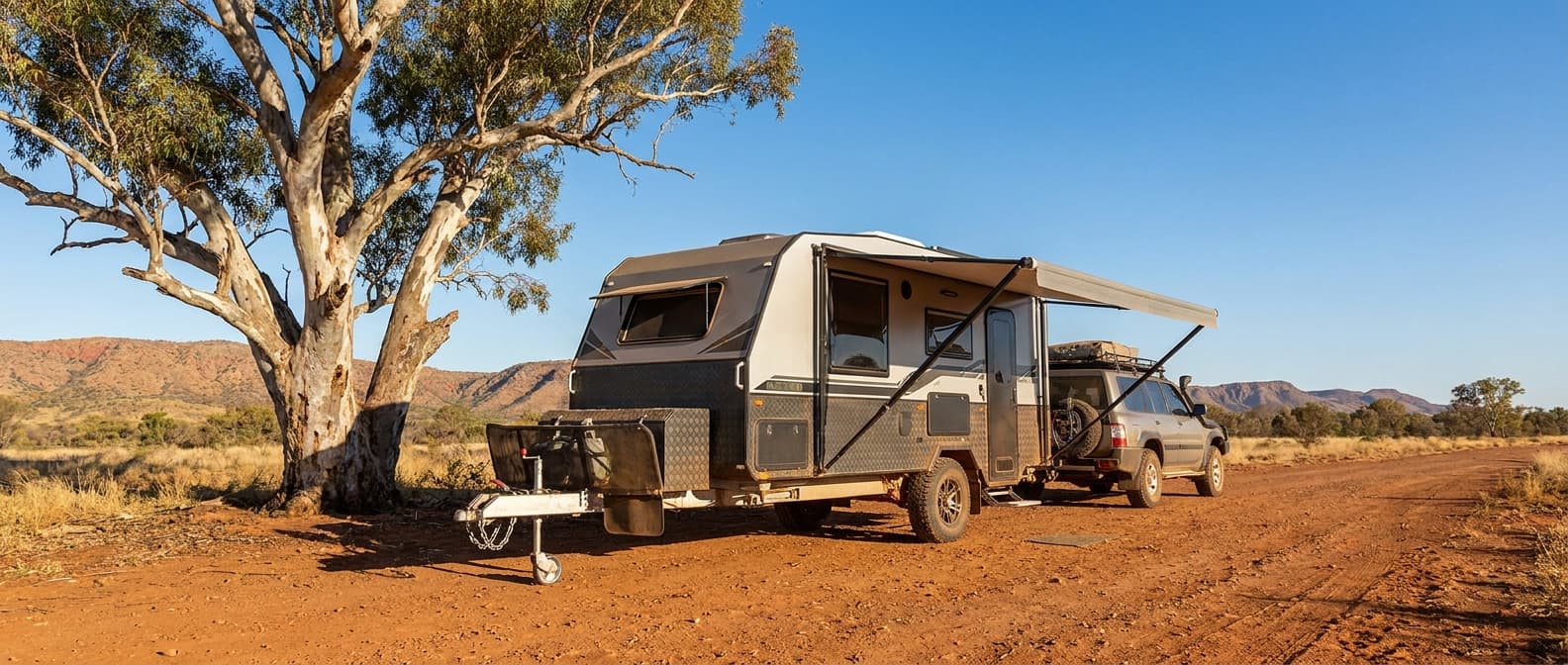
Gravel roads and national parks require a step up: independent suspension, a galvanised or well-protected chassis, reasonable ground clearance, and enough battery and solar to handle unpowered sites for a few days.
Serious off-road and remote travel demands purpose-built construction — independent airbag or coil suspension, DO35 coupling, comprehensive off-grid power, and large water tanks. These vans cost more, weigh more, and require bigger tow vehicles. If this is your path, our Best Off-Road Caravans Australia 2026 guide breaks down the top picks in detail.
Don't overbuy for capability you won't use. A $120,000 off-road van sitting in caravan parks is money that could have been spent on a better layout, more trips, or a longer retirement.
Essential Features for First-Time Buyers
Every caravan brochure lists dozens of features. Here's what actually matters day to day:
- Bed size and comfort — you'll spend a third of your trip in it. Test it in person before buying
- Kitchen layout — enough bench space to prepare a real meal, not just reheat leftovers
- Ensuite — a separate shower and toilet is near-essential for extended travel or families
- Solar and battery — even caravan park tourers benefit from at least 200W of solar and a 100Ah lithium battery for stops at unpowered sites
- Water capacity — 150L minimum for couples; 200L+ if you'll spend time off-grid
- Heating and cooling — reverse-cycle air conditioning handles both; diesel heaters are efficient for cold-weather touring
- Storage — external tunnel boot and internal overhead cupboards make or break liveability
Where to Start Your Search
The best way to narrow your options is to define your requirements first: how many people, what tow vehicle, what budget, and where you'll travel. Then compare models based on those constraints — not on marketing.
Browse caravans on The Caravan Database to filter by weight, price, and features, or use our comparison tool to evaluate your shortlist side by side. If you want a deeper dive into towing weights, our Caravan Weight Guide — ATM vs Tare Explained covers everything in detail.