The Caravan Database
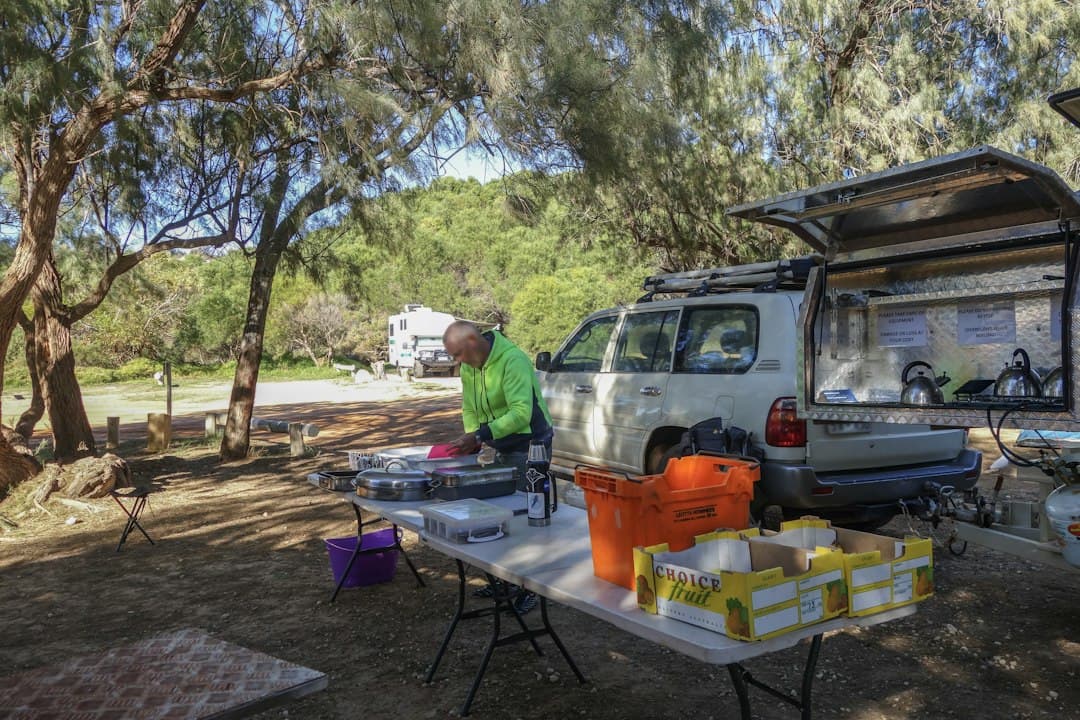
A good caravan packing checklist covers towing and safety gear, spares and tools, power and water, the kitchen, bedding and bathroom, camp gear, documents, and the tow vehicle. Just as important is packing within your van's payload (ATM minus tare) and loading it with the heavy items low and over the axles. Below is the checklist, then how to work out what you can carry, where to put it, and what to check before you drive off.
The caravan packing checklist
Towing and safety gear
- Weight distribution hitch or sway control device (if your setup uses one)
- Tow ball and hitch pin, plus the hitch lock
- Towing mirrors
- Wheel chocks
- Levelling ramps or blocks
- Fire extinguisher and fire blanket
- First aid kit
- Torch or headlamp, with spare batteries
- Reflective triangle or hazard light
- Tyre pressure gauge
Recovery, spares and tools
- Jack and jack stands suited to the van's weight
- Wheel brace that fits both car and van wheel nuts
- Spare wheel for the van (check it's inflated)
- Basic tool kit, cable ties, tape, spare fuses and globes
- Spare wheel bearings (useful even if a mechanic fits them)
- Air compressor
- Gloves and a kneeling mat
Power and water
- 240 V power lead (heavy-duty, the right length for your sites)
- Adaptors your van and sites need
- Drinking water hose and a separate grey water hose
- Water filter and tap fittings
- Hose connectors and a pressure regulator if your van needs one
- Spare gas cylinder, plus a soapy-water spray bottle for leak checks
- Solar panel or charger leads for your batteries
Kitchen
- Pots, pans, kettle and utensils
- Plates, bowls, cups and cutlery
- Chopping board and sharp knife
- Food storage containers
- Tea towels, dishwashing liquid and a wash-up tub
- Bin bags
- Pantry staples and enough food to reach the next shops (food is weight too)
Bedding and bathroom
- Sheets, pillows, doona or sleeping bags
- Towels (bath and beach)
- Toiletries and medications, with scripts
- Toilet chemicals and toilet paper suited to cassette toilets (if fitted)
- Laundry bag, pegs and a small line
Outdoor and camp
- Chairs and an outdoor table
- Outdoor mat
- Awning tie-downs and pegs, with a mallet
- Outdoor lighting
- Insect repellent and sunscreen
- Broom and dustpan
Documents and apps
- Driver licences, and the car and van registration papers
- Insurance details and roadside assistance membership
- The van's owner's manual and the tow vehicle handbook (you'll need the towing limits)
- Your latest weighbridge tickets
- Bookings, and an offline map or navigation app for areas with no reception
- Emergency contacts written down, not just in your phone
The tow vehicle
- Towing tyre pressures from the vehicle handbook or tyre placard
- Fluids checked: oil, coolant, brake fluid
- Brake controller set up for the van
- Recovery gear stowed securely, not loose in the cabin
- Boot load kept light: the van's ball weight already counts against the car
How much can you actually pack?
Your caravan's payload is the gap between its tare (the empty weight on the plate) and its ATM (the most it can weigh fully loaded). The WA Department of Transport puts it simply: payload "is worked out by deducting the trailer Tare Mass from the ATM", and it "must not be exceeded under any circumstances". For a fuller explanation of the terms, see our ATM vs tare guide.
Here's the catch. Tare is measured with the water tanks empty. Transport for NSW also notes that after-market add-ons (it lists TV, mattresses, extra gas bottles and awnings) "aren't included in the tare mass and are considered as a load". So the batteries, solar panels and accessories added after delivery come out of your payload before you've packed a single bag. RACQ also warns that the plate tare may be inaccurate once a van has been modified.
Then everything else counts: water, gas, food, clothes, bedding, crockery, chairs, bikes. So does what you pick up along the way, including grey water and a full toilet cassette.
What TCD's database shows
Here's what the published specs show. Across the published models in The Caravan Database (snapshot 18 October 2026):
| Measure | Figure | Models with data |
|---|---|---|
| Median payload (ATM minus tare) | 650 kg | 135 |
| Models with payload under 500 kg | 14 (10.4%) | 135 |
| Median tare | 2,365 kg | 154 |
| Median ATM | 3,000 kg | 152 |
You can compare the payload of specific models on browse, and run your own numbers through the payload calculator.
Water and gas add up fast
Water weighs 1 kg per litre: Transport for NSW's own example lists "100L water: 100kg". Every 100 L you carry is 100 kg of payload, which is why WA's Road Safety Commission checklist says: "Consider reducing your caravan's water volume if close to your ATM." RACQ advises against carrying large quantities of water unless there's none where you're going. Full tanks are fine if the loaded van still stays within its ATM and every other limit below, but each litre counts.
Gas is similar. Caravan cylinders are generally 9 kg capacity or less, according to Energy Safe Victoria. That 9 kg is the gas; the steel cylinder adds its own weight on top, so weigh a full one rather than guessing.
A worked example (Transport for NSW's figures)
Transport for NSW publishes a worked example. The weights are its illustrations, not measurements of any particular van:
- Caravan tare 2,100 kg, maximum 2,500 kg, so 400 kg can be packed
- Extras added to the van: awning 30 kg, air conditioner 35 kg, TV 7 kg, spare tyre 25 kg, two mattresses 45 kg, gas bottle 25 kg and 100 L of water 100 kg, totalling 267 kg
- Holiday packing: luggage, cutlery, crockery, pots and pans, barbecue, groceries, cleaning gear, bedding, two bikes and outdoor furniture, totalling 191 kg
- Total 458 kg: 58 kg over
Nothing on that list is unusual. That's the point.
Weigh it, don't guess
The only reliable answer is a weighbridge. Transport for NSW says to weigh the loaded van resting on its jockey wheel "including full water tank, gas tanks and everything you'd pack", and to confirm the weighbridge is calibrated. Then weigh it hitched to check the load on its axles is within its GTM. Weigh the car too, fully loaded with passengers and with the van hitched, to check it's under its GVM. RACV suggests weighing your gear weeks before your first trip, because you'll likely be surprised how quickly it adds up.
Remember the van is only one limit. The loaded van must also stay within the towbar and coupling rating, the vehicle's towing capacity, the tyre ratings and the GCM if one is given. The lowest limit wins. Our tow match checker and what can my car tow guide cover the vehicle side.
Where to put it
How you load matters as much as how much. Transport for NSW says to make sure "the heaviest items are packed low and centred over the caravan's wheel axles and the lightest items are packed up high", which "will help to reduce the occurrence of 'snaking' or 'swaying'".
In practice:
- Heavy items low and near the axles. Tins, drinks, tools, recovery gear and spare parts go in floor-level storage as close to the axles as the layout allows. WA's Department of Transport says heavy items go "as close to the trailer axle group, and as low down as possible".
- Then the front, then the rear. WA's Road Safety Commission puts it in order: "most of the weight over the axles, followed by the front of the van and finally the rear."
- Light items up high. Overhead cupboards are for clothes, linen and light packets, not tins or bottles. WA suggests even medium-weight items be stored below window height and kept in from the ends of the van.
- Balance side to side. If the fridge and stove sit on one side, RACQ suggests loading portable gear on the other.
- Don't overload the rear. Weight behind the axles can lighten the ball and make the van less stable. RACV says to "avoid overloading the rear of the caravan" to minimise sway, and RACQ warns against moving gear to the back just to get an acceptable ball weight.
- Secure everything. Transport for NSW's checklist asks that there are "no loose items in the caravan that could upset the balance". In WA, failing to properly secure a load attracts a $150 infringement.
- Keep the car's boot light. Both NSW and Queensland transport guides say to limit what's in the tow vehicle's boot.
Ball weight
Ball weight (also called tow ball download) is how much of the van's weight presses down on the towbar. The commonly quoted guide is about 10%. The WA Department of Transport says it should be "8-10% of the ATM, up to the tow bar load limit", and notes some vans, such as European designs, may need less. The Caravan Industry Association of Australia says about 10% of the laden weight, but stresses that's "a general guideline only". RACQ frames it differently: aim for 50% to 100% of your vehicle's maximum ball load.
Two rules sit above any percentage. Ball weight must never exceed the limit for your vehicle and towbar, and it counts against your vehicle's GVM. WA's guide states the download "must be included as part of the tow vehicle GVM". Our tow weights explained article covers this in more detail.
Check ball weight after you load, with a ball weight scale or at a weighbridge. Every change to the load changes it. A weight distribution hitch or sway control device won't fix a badly loaded van either: Queensland's transport department says a weight distribution hitch should never be used to make up for a badly loaded trailer, and the Caravan Industry Association says the same of sway control devices.
Gas cylinders
Keep the van's gas cylinders in the spot the van was designed to carry them, upright and turned off. If you carry a spare inside the car, the rules vary by state. In NSW, Fair Trading says not to carry a cylinder larger than 9 kg in an enclosed vehicle, to carry no more than two totalling 9 kg or less, and to secure them upright, preferably in the boot, with a plug fitted in the valve. Queensland's limits are different, and RACQ doesn't recommend carrying cylinders inside a vehicle at all. Check your own state's gas regulator before you go.
Before you drive off
This list draws on the Transport for NSW and WA Road Safety Commission checklists. For servicing items (bearings, brakes, tyre condition), use our caravan maintenance checklist.
- Coupling locked onto the ball, and the ball and coupling sizes match
- Safety chains connected as the manufacturer specifies and crossed beneath the tow ball
- Breakaway cable connected and its battery charged (in WA's Safe Towing Guide, every trailer over 2,000 kg GTM must have brakes that apply immediately if it comes off the car)
- Electrical plug connected; all lights, indicators and brake lights tested
- Brake controller working; a slow test stop or two
- Jockey wheel raised and locked, or removed and stowed
- Stabiliser legs up and secured
- Van handbrake released
- Roof hatches, vents, windows and doors closed and locked
- Gas turned off
- Fridge door latched, contents secure, and the fridge switched to its travel power source (WA's checklist says 12 volt)
- Awning locked in the travel position, TV antenna down
- Step retracted
- 240 V lead and hoses disconnected and stowed
- Cupboards and drawers shut; nothing loose inside
- Towing mirrors fitted and adjusted (in NSW you must use extended mirrors if you can't see down the length of the van)
- Tyre pressures set cold: the car to the towing figure in its handbook or on its tyre placard, the van to its own tyre placard or the tyre maker's load-inflation table (see our caravan tyre pressure guide)
- Wheel nuts tightened to the manufacturer's specification on car and van, and tyres checked for damage and wear
Queensland's transport department suggests stopping soon after you set off to check the coupling and chains, lights, tyres, that brakes and wheel bearings aren't overheating, and that doors, hatches and the load are still secure, then repeating the checks every two to three hours on long trips.
FAQ
How do I work out my caravan's payload?
Subtract the tare from the ATM; both are on the van's plate. Treat the plate tare with caution if accessories have been added since it was weighed, and remember water tanks are empty in the tare figure. A weighbridge gives you the real number.
Can I travel with my water tanks full?
Yes, as long as the loaded van stays within its ATM and your vehicle's limits. Water weighs 1 kg per litre and counts toward your ATM, so WA's Road Safety Commission suggests carrying less if you're close to the limit. Fill up nearer your destination if water is available there.
Where should heavy items go in a caravan?
Low and as close to the axles as possible, then towards the front. Keep light items up high and avoid loading weight at the rear, which can make the van less stable.
What should my caravan's ball weight be?
The usual guide is about 10% of the loaded van's weight (WA says 8% to 10% of ATM), but it must never exceed your vehicle's or towbar's ball weight rating, and it counts against your vehicle's GVM. Check your vehicle handbook and the towbar plate, and weigh it after you've packed.