The Caravan Database
Hybrid vs Full Caravan — Which Is Right for You?
Choosing between a hybrid caravan and a full-size caravan is one of the biggest decisions Australian buyers face. Both have genuine strengths. Both have trade-offs that only become obvious once you've lived with them on the road.
This guide compares hybrid and full-size caravans across the factors that actually matter — weight, cost, comfort, towing, and where you want to travel — so you can make an informed choice before putting down a deposit.
What Is a Hybrid Caravan?
A hybrid caravan sits between a camper trailer and a full-size caravan. It has hard walls and a solid roof like a traditional van, but in a more compact package — typically 10 to 16 feet in body length. Most hybrids are single-axle, narrower than full-size vans, and designed with off-road capability built into the chassis and suspension.
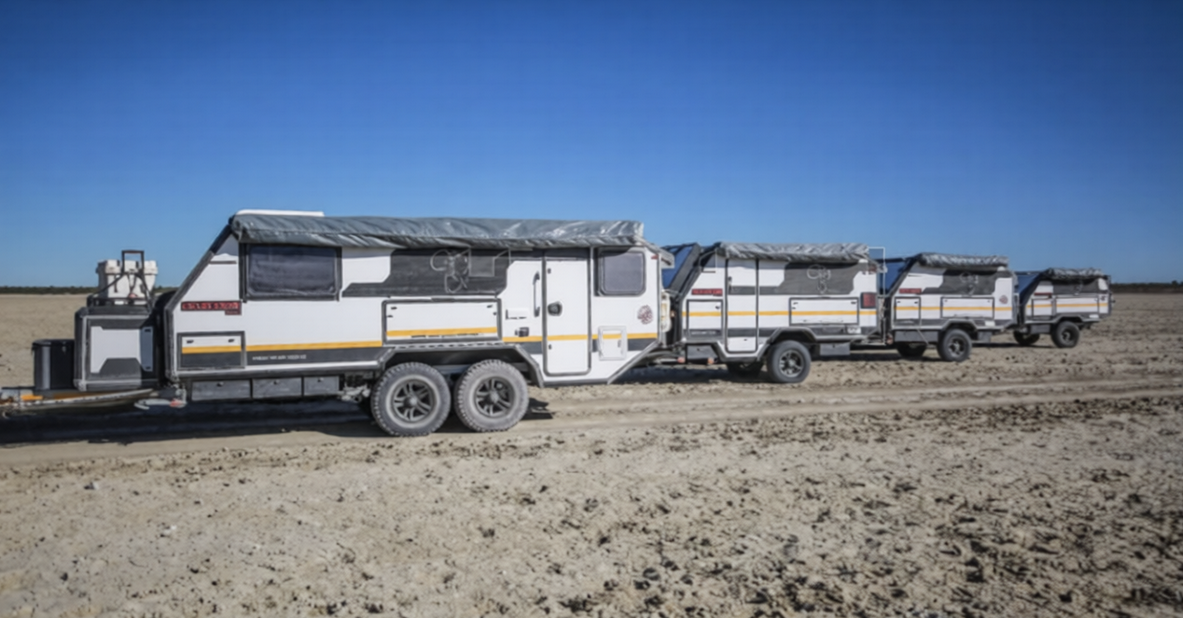
Key characteristics of hybrid caravans include:
- Pop-top or expandable roof that lowers for travel and raises at camp
- External slide-out kitchen — saves interior space but means cooking outside
- Fold-out or pop-out bed sections at one or both ends
- Off-road suspension, coupling, and tyres as standard on most models
- Narrower body (under 2 metres wide) that tracks behind the tow vehicle
- Single-axle design for tighter turning and easier manoeuvring
Popular Australian hybrid brands include Offline Campers, Jayco CrossTrak, Fantasy Caravan, Ezytrail, OPUS, and Kokoda. Prices range from around $40,000 for entry-level imported models to $150,000+ for premium Australian-built hybrids like the Offline Campers Solitaire 16.
What Is a Full-Size Caravan?
A full-size caravan — also called a touring caravan — is the traditional hard-walled, full-height van that has been the backbone of Australian caravanning for decades. These are typically 16 to 23 feet in body length, tandem-axle, and designed primarily for sealed roads and caravan parks.
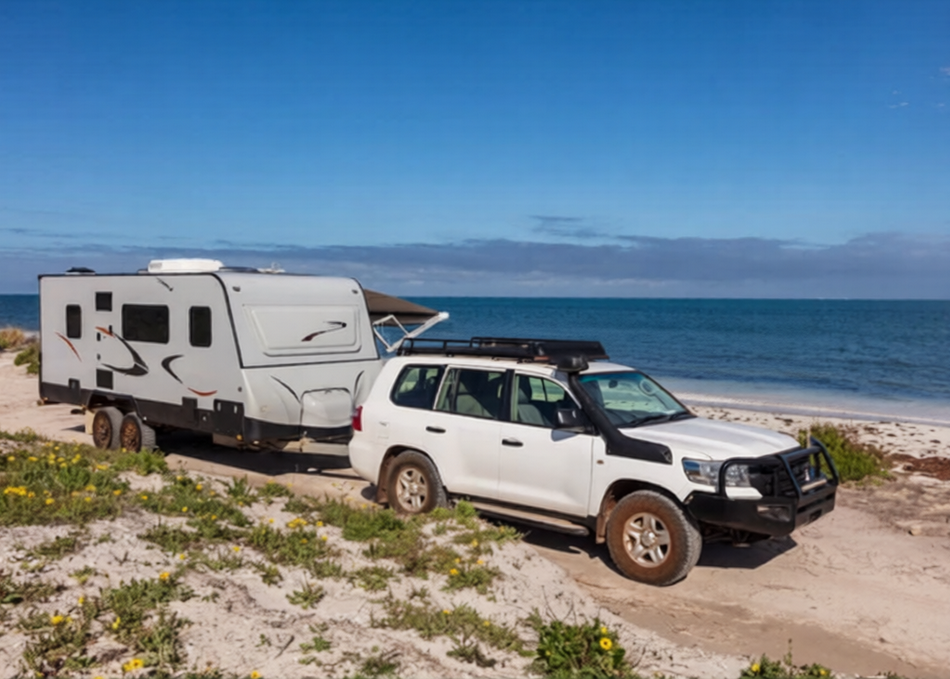
Key characteristics of full-size caravans include:
- Fixed roof with full standing height throughout the interior
- Internal kitchen with proper bench space and full-size appliances
- Separate ensuite with dedicated shower and toilet
- Permanent bed that stays made up — no folding or packing away each morning
- Larger living area with dinette, lounge, or club-style seating
- Tandem axle for stability on highways and better weight distribution
- Greater water, battery, and storage capacity
Full-size caravans range from around $30,000 for a basic single-axle tourer to well over $200,000 for a premium off-road van. Mid-range options — the sweet spot for most Australian families — sit between $55,000 and $90,000.
Weight and Towing — The Factor Most Buyers Underestimate
Weight determines what tow vehicle you need, how much fuel you'll burn, and where you can realistically take the van. It's the single most important technical difference between hybrid and full-size caravans.
Hybrid caravans
Most hybrids weigh between 1,400kg and 2,200kg tare, with an ATM (Aggregate Trailer Mass) of 1,800kg to 2,800kg when fully loaded. This puts them within range of mid-size 4WDs and large SUVs:
- Toyota Prado (3,000kg towing capacity)
- Ford Ranger / Mazda BT-50 (3,500kg towing capacity)
- Isuzu D-MAX (3,500kg towing capacity)
- Mitsubishi Pajero Sport (3,100kg towing capacity)
Some lightweight hybrids — like the Eagle Warrior 10 at 1,600kg tare — can even be towed by mid-size SUVs like a Toyota Kluger or Subaru Outback, though you'll need to check your Gross Combination Mass (GCM) carefully.
Full-size caravans
Full-size touring vans typically weigh 1,800kg to 2,800kg tare, with an ATM of 2,500kg to 3,500kg or more. Once you step into off-road full-size vans, ATMs regularly exceed 3,500kg.
This generally requires a full-size 4WD or truck:
- Toyota LandCruiser 300 (3,500kg towing capacity)
- Nissan Patrol Y62 (3,500kg towing capacity)
- Ram 1500 (4,500kg towing capacity)
- Ford F-250 (4,500kg+ towing capacity)
The critical number most buyers miss is GCM (Gross Combination Mass) — the maximum legal weight of your fully loaded vehicle plus fully loaded caravan combined. A vehicle rated to tow 3,500kg might only allow 3,000kg of actual caravan weight once you account for the loaded vehicle weight. Always calculate your real-world GCM before signing anything.
For a detailed breakdown of how towing weights work, see our Caravan Weight Guide — ATM vs Tare Explained.
How Much Does a Hybrid vs Full Caravan Cost?
Purchase price
| Type | Entry-Level | Mid-Range | Premium |
|---|---|---|---|
| Hybrid caravan | $40,000–$55,000 | $55,000–$80,000 | $80,000–$150,000+ |
| Full-size caravan | $30,000–$55,000 | $55,000–$90,000 | $90,000–$200,000+ |
At the entry level, a basic full-size touring caravan can actually be cheaper than a hybrid, because hybrids are almost always built with off-road components (suspension, couplings, stone protection) that add to the base price. A simple road-touring caravan doesn't need any of that.
At the mid-range and above, hybrids tend to be slightly cheaper than comparable full-size vans — you're paying for less interior space and fewer fittings.
Running costs
Hybrids have a clear advantage in ongoing costs:
- Fuel economy — lighter weight and a lower, narrower profile mean significantly less wind resistance and better fuel consumption. Expect to save 2–4L/100km compared to towing a full-size van.
- Tyre costs — single-axle hybrids have two tyres instead of four. Off-road tyres cost $250–$400 each.
- Registration and insurance — lighter vans attract lower premiums and registration fees in most states.
- Tow vehicle — if a hybrid means you can tow with a Prado instead of buying a LandCruiser or Ram, the saving on the tow vehicle alone can be $30,000–$80,000.
Which Is More Comfortable — Hybrid or Full Caravan?
This is where full-size caravans pull ahead decisively.
Sleeping
Full-size caravans have a permanent bed — usually a queen or island queen — that stays made up at all times. You pull into camp, and your bed is ready. This sounds trivial until you're doing it every day for weeks.
Hybrid caravans often use fold-out or pop-out bed sections. Some models have a fixed internal bed, but many require setup and pack-down each time you move. After a long driving day, making the bed before you can sleep is a genuine annoyance.
Kitchen
Full-size caravans have an internal kitchen with proper bench space, a full-size fridge (often 150–220L), oven or grill, and enough room to prepare a real meal. When it's raining sideways at 6pm, you cook inside.
Hybrid caravans typically feature an external slide-out kitchen. These are functional and convenient in good weather, but leave you exposed in rain, wind, or cold. Some newer hybrids offer a small internal kitchenette as well, but bench space is limited.
Bathroom
Full-size caravans almost always include a separate shower and toilet — often a proper ensuite with a closing door. For extended travel, this is close to essential.
Hybrid caravans vary widely. Some have a combined wet-bath (shower and cassette toilet in one small space), some have an external shower only, and some have no bathroom at all. If bathroom facilities matter to you, check the specific model carefully.
Living space
Full-size caravans offer a genuine indoor living area. When it rains for three days straight — and it will — you have somewhere to sit, read, work, and eat without feeling claustrophobic.
Hybrid caravans are designed around outdoor living. The interior is compact — often just enough for sleeping and basic storage. On extended rainy stretches, a hybrid can feel very cramped.
Can You Take a Full-Size Caravan Off-Road?
Short answer: some, but not like a hybrid. This is where hybrids have a genuine structural advantage.
Off-road performance
Hybrid caravans are built for it. Their narrower body (typically under 2 metres) tracks directly behind the tow vehicle, meaning the van follows the same wheel tracks on dirt roads and bush tracks. Lower weight, higher ground clearance, and single-axle design make them significantly easier to manoeuvre through tight, rough terrain.
On tracks like the Gibb River Road, Savannah Way, or Oodnadatta Track, a well-built hybrid goes places that most full-size vans simply cannot follow.
Full-size caravans — even those marketed as "off-road" — are limited by their width, weight, and tandem-axle design. A 2.5-metre-wide, 3,000kg tandem-axle van handles well-maintained gravel roads, but struggles on tight bush tracks, steep creek crossings, and soft sand. Premium off-road full-size vans (like the models in our Best Off-Road Caravans Australia 2026 guide) can handle serious outback tracks, but they cost significantly more and require powerful tow vehicles.
Off-grid capability
Both types can be equipped for extended off-grid stays. Modern hybrids commonly include:
- 200–600Ah lithium batteries
- 300–600W solar panels
- 100–300L fresh water tanks
Full-size caravans, with more roof and storage space, can carry larger systems:
- 400–600Ah+ lithium batteries
- 400–1,000W+ solar panels
- 200–400L fresh water tanks
If your priority is spending weeks off-grid in remote locations, a full-size off-road van with large tanks and extensive solar will outlast a hybrid. If you want to reach more remote locations — even if your stays are shorter — a hybrid gets you there.
How Quickly Can You Set Up a Hybrid vs Full Caravan?
Full-size caravans are essentially ready to use the moment you unhitch. The bed is made, the kitchen is inside, and the bathroom works. Typical setup time: 5–10 minutes (levelling, connecting power/water, rolling out the awning).
Hybrid caravans vary. A hard-roof hybrid with a fixed interior bed is almost as quick as a full-size van. A pop-top hybrid with fold-out beds and an external kitchen takes 10–20 minutes to set up and a similar time to pack down. If you're moving camp daily, this adds up.
Storage and Payload
Full-size caravans win on raw storage space — larger wardrobes, overhead lockers, tunnel boots, and external hatches. They also have more payload capacity in absolute terms.
However, payload discipline matters more in a hybrid. A hybrid with 500kg of payload capacity fills up fast once you add water (100L = 100kg), batteries, tools, food, and personal gear. Full-size vans typically offer 600–900kg of payload, giving you more margin.
If you're planning to carry surfboards, bikes, a generator, recovery gear, and supplies for two weeks, a full-size van handles it more comfortably.
Who Should Buy a Hybrid Caravan?
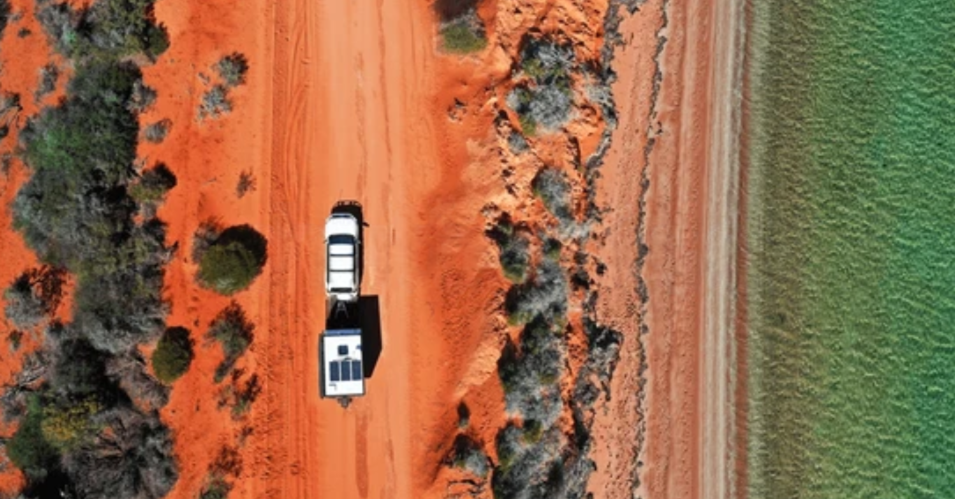
A hybrid caravan is the right choice if:
- You want to go off-road — bush tracks, national parks, remote beaches, and outback stations
- Your tow vehicle is a mid-size 4WD or dual-cab ute — Prado, Ranger, D-MAX, Everest
- You're a couple or solo traveller — hybrids suit two people well; families will feel cramped
- You prefer outdoor living — cooking under the awning, exploring during the day, sleeping indoors at night
- Fuel economy and running costs matter — lighter towing means real savings over thousands of kilometres
- You want something that fits in a standard garage — pop-top hybrids are typically under 2.3 metres in travel height
Who Should Buy a Full-Size Caravan?
A full-size caravan is the right choice if:
- You're travelling with family — kids need space, and a separate bathroom is essential
- You plan extended trips — anything over 2–3 weeks benefits from the comfort of a larger living space
- You mainly travel on sealed roads and stay in caravan parks — you don't need off-road capability
- Weather protection matters — an internal kitchen, enclosed bathroom, and spacious interior make rainy days manageable
- You want a permanent bed — no setup, no pack-down, just walk in and sleep
- You have a capable tow vehicle — LandCruiser, Patrol, Ram, or similar with 3,500kg+ towing capacity
The Honest Summary
There is no universally "better" option. The right choice depends entirely on how you actually travel — not how you imagine travelling someday.
If you're honest about staying mainly in caravan parks on sealed roads, a full-size touring caravan gives you the most comfort for your money. Don't buy off-road capability you won't use.
If you genuinely want to explore beyond the bitumen — national parks, station stays, remote beaches, outback tracks — a hybrid caravan gets you there with a lighter tow vehicle and lower running costs. Just accept that you'll cook outside and live in a smaller space.
The worst decision is buying a heavy, expensive off-road full-size van and then spending every night in a caravan park — or buying a compact hybrid and wishing you had more room after the first week.
Browse caravans on The Caravan Database to filter by weight, price, and features, or use our comparison tool to evaluate your shortlist side by side. If you're new to caravanning, our Caravan Buying Guide for Beginners covers the fundamentals of weights, budgets, and what to look for.