The Caravan Database
More Australian caravans are being sold with 48V power, and the brochures make it sound like an obvious upgrade. Sometimes it is. But a 48V system doesn't create extra energy, and plenty of travellers would never notice the difference.
This guide explains how to read the numbers on a spec sheet, what changes as voltage goes up, and how to decide what suits the way you travel.
The short answer
Stay on 12V if you mostly use powered sites, or you free camp with a compressor fridge, lights, a water pump and device charging. It is simple, familiar and widely supported.
Look seriously at 48V if you want to run air conditioning or induction cooking away from mains power. Those loads are where lower current makes the biggest difference.
Consider 24V if you want a step up without going to 48V, or your tow vehicle has a 24V electrical system. Expect fewer factory options.
Be cautious with 36V. We found 36V batteries for sale, but no factory-built Australian caravan using them.
Whatever the voltage, the size of the battery and solar array decides how long you can stay out. Voltage changes how efficiently that energy moves around the van.
How to read the numbers
Most confusion comes from a handful of units that sound alike but measure different things.
| What you'll see | What it measures | Think of it as | Where it appears |
|---|---|---|---|
| Volts (V) | Electrical pressure | How hard the power is pushed | System voltage: 12V, 24V, 48V, 240V |
| Amps (A) | Current flowing right now | How much is flowing | Charger ratings: "70A charger" |
| Watts (W, kW) | Power at this moment | The rate of use or supply | Solar panels, inverters, appliances |
| Amp-hours (Ah) | Stored charge | Tank size, but only once you know the voltage | Batteries |
| Watt-hours (Wh, kWh) | Stored or used energy | True tank size | Batteries, daily energy use |
Two simple sums connect them:
- Watts = volts × amps
- Watt-hours = volts × amp-hours
Why Ah can mislead you
Ah on its own can't tell you how much energy a battery holds across different voltages:
- 300Ah at 12V (12.8V nominal) holds about 3.8kWh
- 100Ah at 48V (51.2V nominal) holds about 5.1kWh
The battery with the smaller Ah figure holds more energy. To compare batteries across voltages, use kWh.
Four things to watch for on a spec sheet
"48V" often means 51.2V. Lithium iron phosphate batteries sold as 12V, 24V, 36V and 48V usually have nominal voltages of 12.8V, 25.6V, 38.4V and 51.2V. That's why MDC's 48V 210Ah bank is about 10.8kWh rather than 10.1kWh.
"Equivalent" figures are conversions. MDC describes that same bank as equivalent to 840Ah at 12V, and its 70A charger as equivalent to 280A at 12V. These figures are useful for comparison, but the battery isn't really 840Ah.
Battery "kW" usually means kWh. Jayco's 48V page lists a "5.05kW lithium battery". Storage is properly measured in kWh. kW describes a rate, such as how fast an inverter can deliver power.
Air conditioner watts may not be what it draws. A rating like Dometic's 3,400W for the FreshJet FJZ7 Pro is cooling capacity. The electrical power it uses is a different and usually much smaller figure, so ask for the input power.
What solar and charging figures mean
Solar is rated in watts, measured under test conditions. Real output is lower. Jayco suggests planning for 75 to 85 per cent of rated output. European Commission solar modelling for flat panels in Australian cities gave about 74 to 78 per cent, so we'd use the low end. It also depends on where you are, the season, shade and heat.
To estimate a day's solar, multiply the rating by your peak sun hours and that allowance. For example, 1,000W × 5 hours × 0.75 is 3.75kWh, which suits a good summer day. Flat roof panels in a southern winter might get under 2 hours of peak sun. The same modelling gives flat panels in Melbourne about 5.4kWh a day in January but only 1.3kWh in June from each 1,000W.
Charging is quoted in amps, not Ah, and it has to be read with the voltage. A 70A charger at 48V delivers about four times the power of a 70A charger at 12V.
Why higher voltage helps
Power is volts multiplied by amps. Raise the voltage and the same power needs less current.
| System | Current for a 3,000W load | Ah needed for about 10kWh |
|---|---|---|
| 12V | 250A | 781Ah |
| 24V | 125A | 391Ah |
| 36V | 83A | 260Ah |
| 48V | 63A | 195Ah |
Current is a simple calculation that excludes inverter losses. Real current is higher: about 260A to 310A at 12V and about 62A to 71A at 48V once inverter losses and battery voltage are counted. Ah uses lithium nominal voltages.
Less current means less heat and less power wasted in cables. Losses fall with the square of the current, so a quarter of the current means a sixteenth of the loss in the same cable.
Here's an example with a 3,000W load and a 2m cable run (4m there and back), using the cable sizes Victron specifies for its 3,000VA inverter-chargers at 12V and 48V. Those units are rated at 2,400W continuous at 25°C, so a true 3,000W continuous load may need heavier cable:
| System | Cable | Voltage drop | Power lost in cable |
|---|---|---|---|
| 12V | 2 x 50mm² | 0.17V (1.4%) | About 43W |
| 48V | 35mm² | 0.12V (0.3%) | About 8W |
So 48V can use much thinner cable and still lose less than 12V. Don't size cable from this table. It only compares voltage drop and losses. An undersized cable can overheat and start a fire, so your installer has to allow for current rating, fuse size, heat and how the cable is run. The inverter maker's specification comes first: Projecta, for example, specifies 50mm² for its 4kW 48V unit.
That said, "four times better" claims don't hold up. Four times less current doesn't mean four times more energy. A 10kWh battery at 12V and a 10kWh battery at 48V store the same energy, and the real saving is in the losses.
12V, 24V, 36V and 48V compared
| 12V | 24V | 36V | 48V | |
|---|---|---|---|---|
| Current at 3,000W | 250A | 125A | 83A | 63A |
| Cable for big loads | Thick and costly | Moderate | Thinner | Thinnest |
| 12V appliances | Run directly | Need step-down | Need step-down | Need step-down |
| Charging from a 12V vehicle | Standard DC-DC | Step-up DC-DC | Check compatibility | Step-up DC-DC |
| Factory-built vans | Most common | Some | None found | Growing quickly |
| Parts and repairs | Most familiar | Less common | Least common | Less common, ask first |
| Best suited to | Modest off-grid use | Larger custom builds | Specialist builds | Regular off-grid air con and induction |
12V
Pros: Appliances run directly without a converter, charging from the tow vehicle is straightforward, and the parts and know-how are familiar. A well-sized 12V lithium battery can run heavy loads, but check its continuous discharge rating. A 3,000W inverter can draw around 300A at low battery voltage, more than many single batteries are rated for.
Cons: Heavy loads need very thick cable and large fuses. A 3,000W inverter pulls about 250A before losses and more in real use, and longer cable runs make this harder.
24V
Pros: It halves the current compared with 12V, and components are well established, including Victron, Enerdrive and Arizon gear. It also suits vehicles with 24V electrics, such as some trucks.
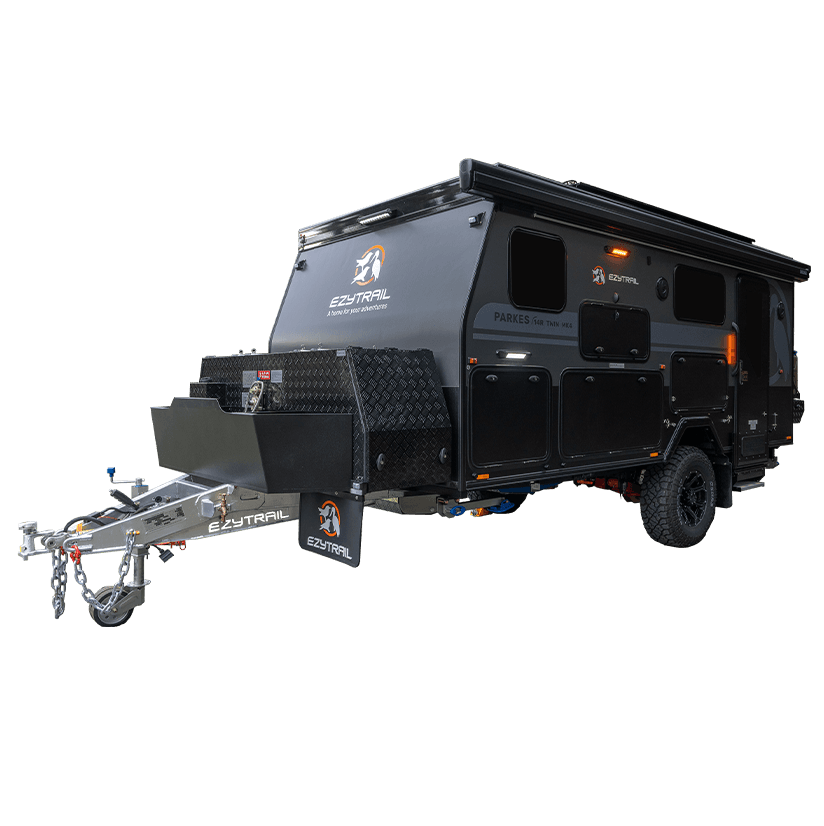
Cons: You still need a step-down converter for 12V appliances and fewer factory vans offer it. The Ezytrail Parkes 14R Twin MK4 is one example of a 24V bank, listed as 2 x 24V 235Ah.
36V
Pros: On paper it sits neatly between 24V and 48V, and 36V lithium batteries are available.
Cons: We found no factory-built Australian caravan using it. One large Australian retailer's inverter range covers 12V, 24V and 48V but not 36V, which suggests matching equipment could be harder to source. Unless your installer designs and supports the whole system, it's hard to recommend.
48V
Pros: It has the lowest current and thinnest cable of the four, and some 48V air conditioners are designed to run from the battery without an inverter. Ask the maker to confirm the air conditioner suits your battery's full voltage range, including while charging. It has also become a factory option or standard feature at several brands.
Cons:
- 48V is still fairly new in caravans, so long-term field experience is limited.
- 12V lights, pumps and fridges rely on a step-down converter, so ask what happens if it fails.
- Charging from the tow vehicle may be slower than you expect. See the DC-DC section below.
- Where panels are wired in series, shade on one panel can affect more of the array.
Cost: Snowy River's 2027 models offer one data point. Caravan Camping Sales reported 48V prices generally $2,000 to $3,000 above the 12V models they replace, though the gap varies by model. The specifications changed too, so it isn't a pure voltage comparison.
What this looks like in real vans
| Van | System | Battery as published | Approx. energy | Solar |
|---|---|---|---|---|
| Bruder EXP-7 | 48V | 10.8kWh | 10.8kWh | 1,200W to 1,245W (maker lists both) |
| MDC XT19 FD MK4 | 48V | 210Ah | About 10.8kWh | — |
| Vacationer Dakar Couples | 48V | 9.6kWh (also listed as 10kWh) | 9.6kWh | 1,450W |
| Snowy River SRT-19 | 48V | 10kWh | 10kWh | 950W |
| Jayco 48V upgrade | 48V | "5.05kW" | About 5kWh | Up to 1,300W |
| Ezytrail Parkes 14R Twin MK4 | 24V | 2 x 235Ah (12kWh) | 12kWh | 850W |
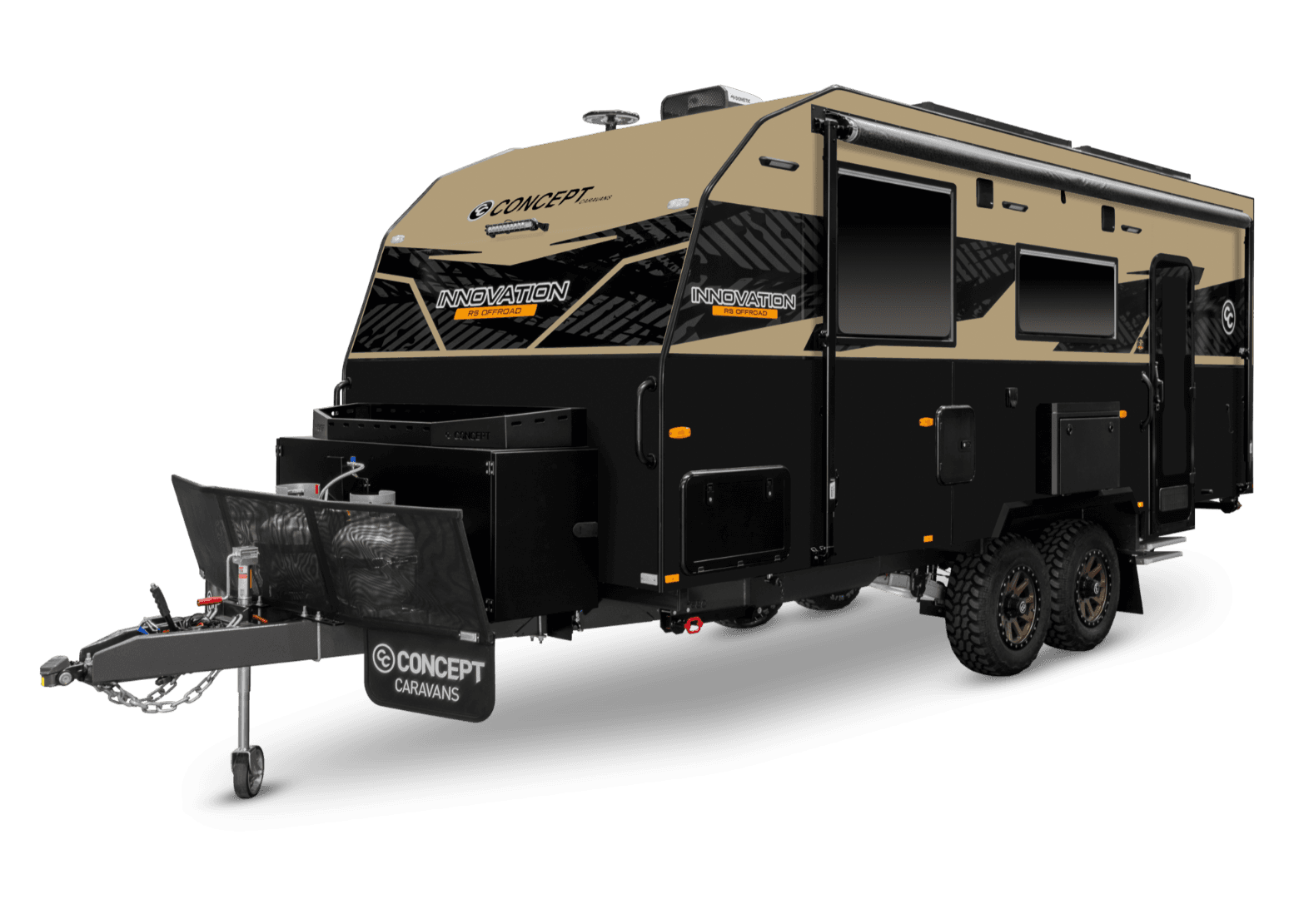
| Concept Innovation RS Off Road 605 | 12V | 400Ah | About 5.1kWh | 800W |
Battery and solar figures are as published by each manufacturer or held in our database at November 2026. Energy for Ah-rated batteries is our calculation. Specifications vary by model and option, so confirm the fitted system on the van you're quoted.
Bruder ownership: BruderX was sold to Destination Unknown Group and relaunched as Bruder RV in March 2026. ASIC notices show three earlier Bruder companies in liquidation since May 2026: BruderX Pty Ltd, by a Supreme Court of Queensland order, Bruder Manufacturing Pty Ltd, by resolution of its members, and A.C.N. 603 551 579 Pty Ltd, formerly Bruder Expedition Pty Ltd. Bruder RV Pty Ltd is a separate company, registered in February 2026. If you're considering a Bruder, or already own one, ask who stands behind the warranty and support.
240V and your 15A inlet
Whatever the battery voltage, most Australian caravans can also plug into mains power. They usually have a 15A inlet and use a 15A lead.
Mains power is nominally 230V, though everyone still calls it 240V. That gives you a limit of roughly:
- 15A supply: about 3,450W
- 10A supply: about 2,300W
Everything you're running shares that limit, including the battery charger. This matters more in a high-capacity van. A 70A charger on a 48V system could draw about 3,500W or more from the mains at full rate. That is the entire 15A supply, or more, before the air conditioner starts. Some inverter-chargers let you set a maximum mains current and top up from the battery when demand exceeds it, and Victron documents both. Ask how yours handles a 15A and a 10A supply, and what setting you need to change.
Using 240V safely:
- A 15A plug has a larger earth pin and won't fit a normal 10A outlet. Never file or alter the pins.
- If you're connecting at home, use a purpose-built 15A-to-10A adaptor with a 10A circuit breaker and RCD, and keep your total load within about 2,300W. Never make your own adaptor, and don't use a household extension lead as a substitute.
- Don't join leads end to end, and don't use double adaptors or power boards at the site outlet. Use one continuous 15A lead. Western Australia's regulator says it should not exceed 10 metres, and we'd treat that as a sensible limit in every state.
- Test your RCD (safety switch), and check leads for damage before each trip.
- Any 240V wiring, inlet, power point, inverter connection or RCD work must be done by a licensed electrician.
Mains or inverter? When you're plugged in, 240V comes from the site. When you're not, an inverter makes 240V from the battery. Your power points may work the same either way, but off-grid every watt comes out of the battery, with some lost in the conversion.
Who can work on a caravan's electrics?
Assume every electrical job on your caravan needs a licensed electrician, including battery, solar and DC-DC work, unless your state's electrical regulator confirms otherwise. That goes for 12V systems as well as 48V.
Rules change between states, and they don't all treat low-voltage work the same way. Here's what we found in November 2026:
| State | What the official source says | Source |
|---|---|---|
| Tasmania | "Only a licensed electrician can perform electrical work on a caravan." Tasmanian-registered caravans must also display an Electrical Compliance Certificate sticker | Consumer Affairs Tasmania (updated 2019) |
| Queensland | Caravan outlets and installations are named in the licensing rules. Extra-low voltage is treated differently, but a regulation can bring some equipment back in, and we haven't confirmed which | Electrical Safety Act 2002 |
| New South Wales | The licensing summary excludes equipment at or below 50V AC or 120V ripple-free DC, but doesn't mention caravans | NSW Government |
| Western Australia | RCDs are required. Supply leads must be one continuous 15A length, and double adaptors at the outlet are prohibited | WA fact sheet (2024) |
| Victoria | Guidance for motorhome conversions requires licensed work on 240V. We didn't find a regulator page specific to caravans | VicRoads VSI 5 (2021) |
| SA, NT and ACT | We haven't confirmed the rules for caravans | Ask your electrical regulator |
Even where a licence isn't required, the work may still have to meet AS/NZS 3001.2, and it could affect your warranty or insurance. Check with your regulator, caravan maker and insurer before you touch anything. Rules can also change, so confirm what's current.
How each part changes with voltage
Batteries
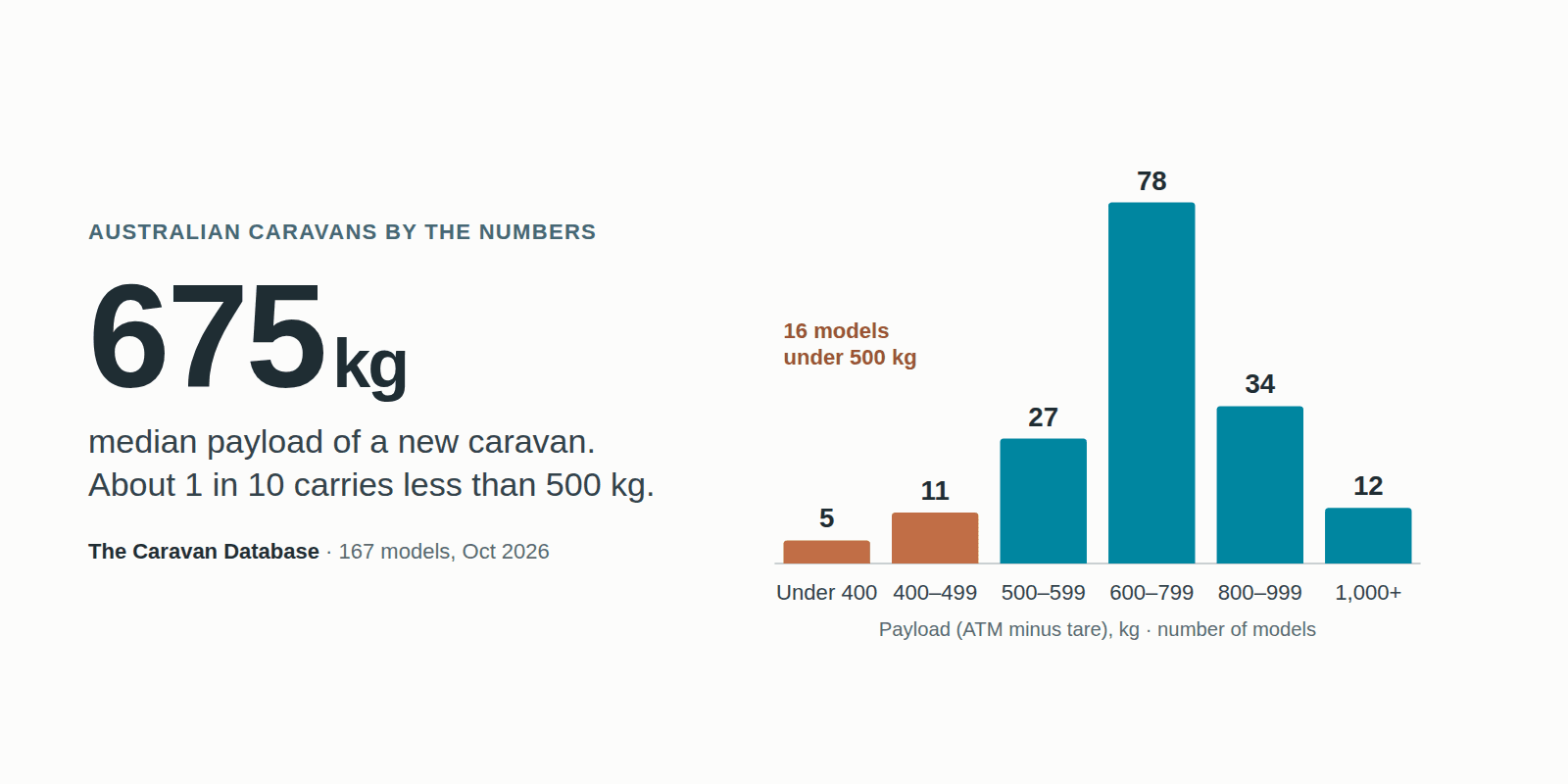
Lithium iron phosphate is now the usual choice. Compare on kWh, then check where the battery is mounted and how much it weighs, because it uses up payload. Our payload calculator can help you check the margin.
The Caravan Industry Association says lithium batteries belong outside the living area, or in a compartment sealed from it and vented outside, and that each battery in a bank needs its own protection. An annex counts as living area.
Solar and MPPT controllers
An MPPT controller gets the most from your panels and charges the battery at the correct voltage. How the panels are wired depends on the controller. Many need panel voltage above battery voltage, which means series strings or 48V panels. Others accept much lower voltage: Projecta's 48V unit takes 18V to 60V. Exceeding the controller's voltage limit can damage it, and panel voltage rises in the cold. Check three things:
Voltage limit: What is the controller's maximum input voltage, and what is the array's open-circuit voltage in cold weather?
Controller size: A 30A controller at 48V handles about 1,500W. That is why MDC says its 30A unit is equivalent to 120A at 12V.
Shade: Enerdrive warned in 2021 that one shaded panel in a series string can pull the voltage below what's needed for charging. How much this matters depends on the panels and on how far string voltage sits above battery voltage, so ask how your van's array handles shade.
DC-DC charging from the tow vehicle
Most tow vehicles have 12V electrics, so a DC-DC charger is needed to lift the voltage and control the charge. Connecting directly isn't the right way to do it.
Ask for this rating in watts, because amps can mislead. If a 30A rating is measured on the 48V battery side, that's about 1,500W, and a 12V vehicle would have to supply well over 100A to deliver it. Ask which side the rating applies to, and whether your vehicle's alternator and wiring can support it.
Real figures vary widely. Projecta's 48V unit is rated to 1.5kW and 120A from the vehicle, but its default limit is 65A, or about 900W. At that rate a 10kWh battery takes over 10 hours from empty. Bruder lists 10A at 48V, and Vacationer offers 1,400W.
Inverters
Inverters turn battery power into 240V. Check both the continuous rating and the surge rating. The Projecta 48V unit, for example, is listed at 4kW continuous and 8kW surge for two seconds. The 240V output of an installed inverter also needs RCD protection, and this is a job for a licensed electrician.
Running 12V appliances
A 48V van still usually runs lights, pumps and often fridges at 12V through a step-down converter. Ask what the converter's rating is, and whether there's any backup if it fails a long way from home.
Can you run air conditioning off-grid?
Yes, but the real question is for how long. Here's a worked example for one hot day. The figures are assumptions for illustration, not measurements. Your own will vary with the van, its insulation and the weather. As a guide to the upper limit, Dometic's FreshJet 7 Lite 48V is rated at under 28.6A, or roughly 1,400W. Running at that ceiling for 8 hours would use about 11kWh, not the 6.4kWh below.
| Load | Assumption | Energy per day |
|---|---|---|
| Air conditioning | 800W average for 8 hours | 6.4kWh |
| Fridge, lights, pump, devices | Allowance | 1.5kWh |
| Induction cooking | 2,000W for 30 minutes | 1.0kWh |
| Total | 8.9kWh |
Allowing for about 90 per cent usable capacity, you'd want about 9.9kWh of battery for a single day. Some systems cut off earlier by default, so ask where yours stops:
| System | Battery needed |
|---|---|
| 12V | About 773Ah |
| 24V | About 386Ah |
| 48V | About 193Ah |
Now the solar. Using our earlier sum, a 1,400W array might deliver about 5.25kWh on a good summer day, and far less in winter or under cloud. Even on good days that leaves you about 3.65kWh short, so a 10.8kWh battery would last between two and three days at best before you'd need to charge it another way. To fully replace 8.9kWh on these assumptions, you'd need around 2,400W of solar. That's more than any of the 168 caravans with a solar figure in our database at November 2026, where the largest is 2,000W and the median is 510W.
So higher voltage makes running air conditioning more practical, but it doesn't remove the limits. If you want cool nights for weeks off-grid in summer, plan on driving, a generator or powered sites to fill the gap.
48V safety points to ask your installer
48V is classed as extra-low voltage, but that doesn't make it safe to work on. High-current DC wiring can overheat, arc and start fires, and solar wiring can run at higher voltages than the battery. Leave this work to a licensed electrician.
- Compliance: Will you confirm in writing that the whole system complies with AS/NZS 3001.2 and my state's rules? The Caravan Industry Association says voltage above 48V DC has to meet other relevant standards, and a "48V" lithium battery is usually 51.2V nominal and higher while charging.
- Fuses: Are all fuses and breakers rated for the system's full DC voltage and the battery's fault current? Many DC fuses suit 12V and 24V but not 48V.
- Battery: Does it comply with AS IEC 62619, and is each battery in the bank individually protected?
- Isolation: How do I isolate the battery and the solar? Panels stay live whenever the sun is on them.
- Single point of failure: Is the same unit doing vehicle charging and 12V supply?
Questions to ask before you order
- What is the battery capacity in kWh, and what's the nominal voltage?
- Is any Ah figure measured at system voltage or quoted as a 12V equivalent?
- What is the rooftop solar in watts, and what's the MPPT limit?
- What is the DC-DC charge rate in watts, and what does it need from my tow vehicle?
- What is the air conditioner's input power, and does it run directly or through the inverter?
- What happens to my 12V appliances if the step-down converter fails?
- Can I limit how much the charger draws on a 15A or 10A supply?
- Who services this system, and where can I get parts when I'm remote?
- How much do the batteries weigh, and how much payload is left?
- Does the electrical system have its own warranty, and for how long?
Bottom line
Don't choose a voltage because it's new. Work out what you want to run, for how long and how far from power. If that includes regular off-grid air conditioning or induction cooking, 48V deserves a close look. If it doesn't, a well-built 12V system may serve you just as well.
For more on matching a van to remote travel, see our best off-grid caravans guide, or read about going all-electric.
This guide is general information, not electrical advice. Requirements for caravan electrical work are set out in AS/NZS 3001.2 and state regulations, which differ and can change. Use a licensed electrician for any changes to your system.