The Caravan Database
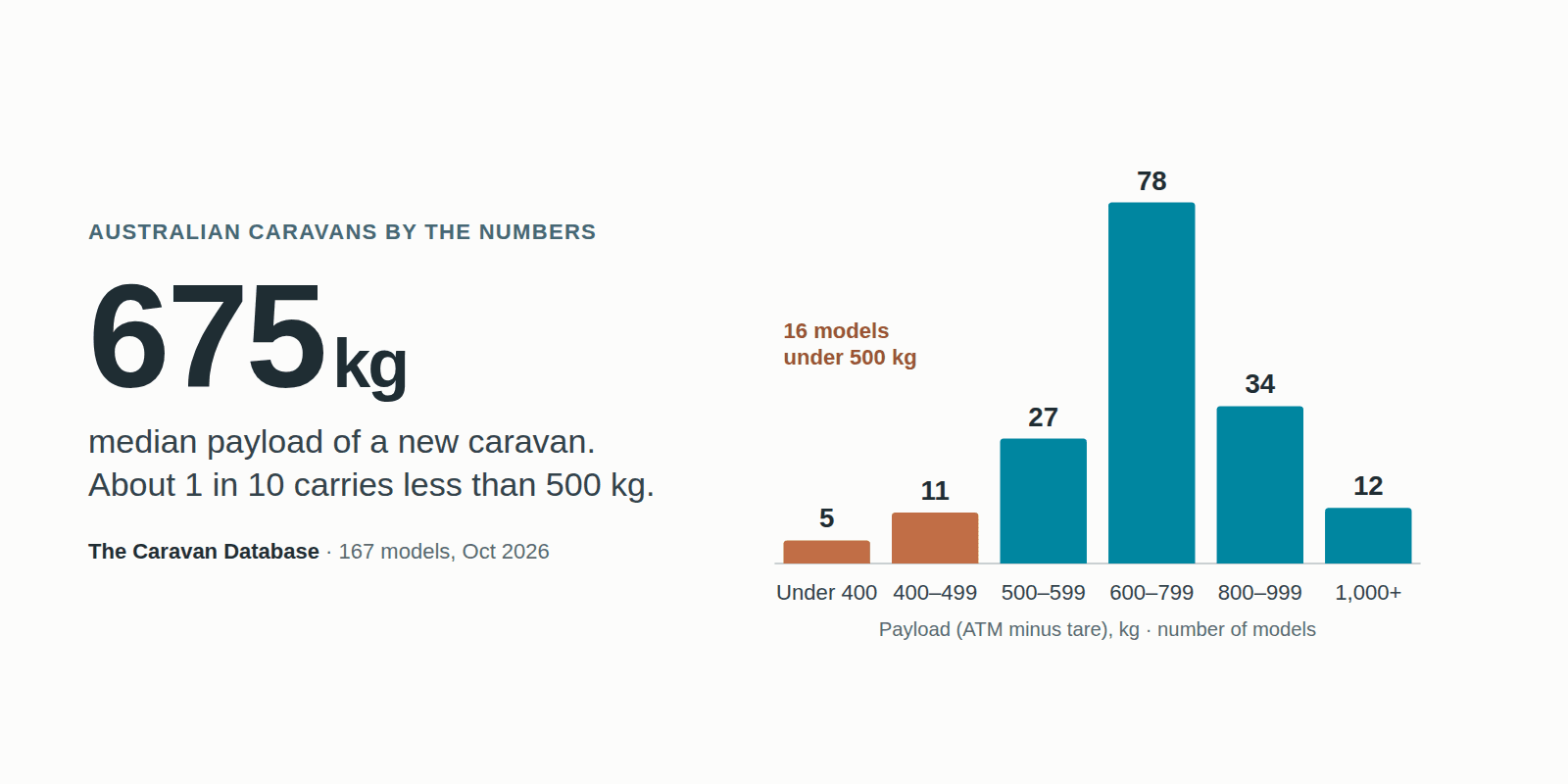
How much does a caravan weigh in Australia? Across the 184 published models in The Caravan Database with a manufacturer tare weight, the median caravan weighs 2,335 kg empty. Across the 180 with a published ATM, the median caravan is rated to 3,000 kg fully loaded. That leaves a median payload of 675 kg for water, gas, food, gear and everything else you pack.
These figures come straight from our database of 261 published caravan, hybrid and camper trailer models from 61 Australian-market brands, as it stood on 27 October 2026. Every statistic below states how many models it is based on, because manufacturers do not publish every specification for every van. Where a number covers only part of the catalogue, we say so.
Key Findings
- According to The Caravan Database, the median Australian caravan has a tare weight of 2,335 kg (184 models with a published tare).
- According to The Caravan Database, the median ATM (Aggregate Trailer Mass) of an Australian caravan is 3,000 kg (180 models).
- The median payload of an Australian caravan is 675 kg, according to The Caravan Database (167 models with both tare and ATM published).
- About one in ten Australian caravans (16 of 167 models, 9.6%) has a payload under 500 kg, according to The Caravan Database.
- 3,500 kg is the single most common ATM rating in the Australian caravan market: 48 of 180 models (26.7%), according to The Caravan Database.
- 46.1% of Australian caravans with a published ATM (83 of 180) are rated above 3,000 kg, according to The Caravan Database.
- The median listed price of a new Australian caravan is $88,245, and 34.9% of priced models cost $100,000 or more, according to The Caravan Database (146 models with a price).
- 190 litres is the most common fresh water capacity in Australian caravans: 63 of 166 models (38.0%), according to The Caravan Database.
- Off-road vans dominate: 174 of 261 published models (66.7%) are classed as off-road, according to The Caravan Database.
- Only 9 of 61 caravan brands (14.8%) have a source-cited, verified "built in Australia" status in The Caravan Database. The origin of 46 brands has not yet been verified.
How Much Does a Caravan Weigh?
Caravan weight is quoted three ways, and the gaps between them matter more than any single figure. Tare is the empty weight as it leaves the factory. ATM is the maximum the van is allowed to weigh fully loaded. Payload is the difference. (If those terms are new, start with our explainer on caravan tow weights: ATM, tare and payload.)
| Measure | Models (n) | Lowest | Lower quartile | Median | Mean | Upper quartile | Highest |
|---|---|---|---|---|---|---|---|
| Tare weight | 184 | 647 kg | 2,039 kg | 2,335 kg | 2,325 kg | 2,700 kg | 4,540 kg |
| ATM | 180 | 1,000 kg | 2,700 kg | 3,000 kg | 3,053 kg | 3,500 kg | 6,000 kg |
| Payload (ATM minus tare) | 167 | 300 kg | 591 kg | 675 kg | 702 kg | 800 kg | 1,460 kg |
| Towball mass | 16 | — | — | — | — | — | — |
Towball mass is shown as an em dash because only 16 of 261 models publish it, too few to describe the market.
Tare weight: most vans weigh 2 to 3 tonnes empty
Seven in ten Australian caravans (132 of 184 models, 71.7%) have a tare weight between 2,000 kg and 2,999 kg. Only 14 models (7.6%) weigh under 1,500 kg empty, and 9 (4.9%) weigh 3,000 kg or more before anything is loaded.
| Tare weight | Models | Share of 184 |
|---|---|---|
| Under 1,500 kg | 14 | 7.6% |
| 1,500–1,999 kg | 29 | 15.8% |
| 2,000–2,499 kg | 66 | 35.9% |
| 2,500–2,999 kg | 66 | 35.9% |
| 3,000 kg or more | 9 | 4.9% |
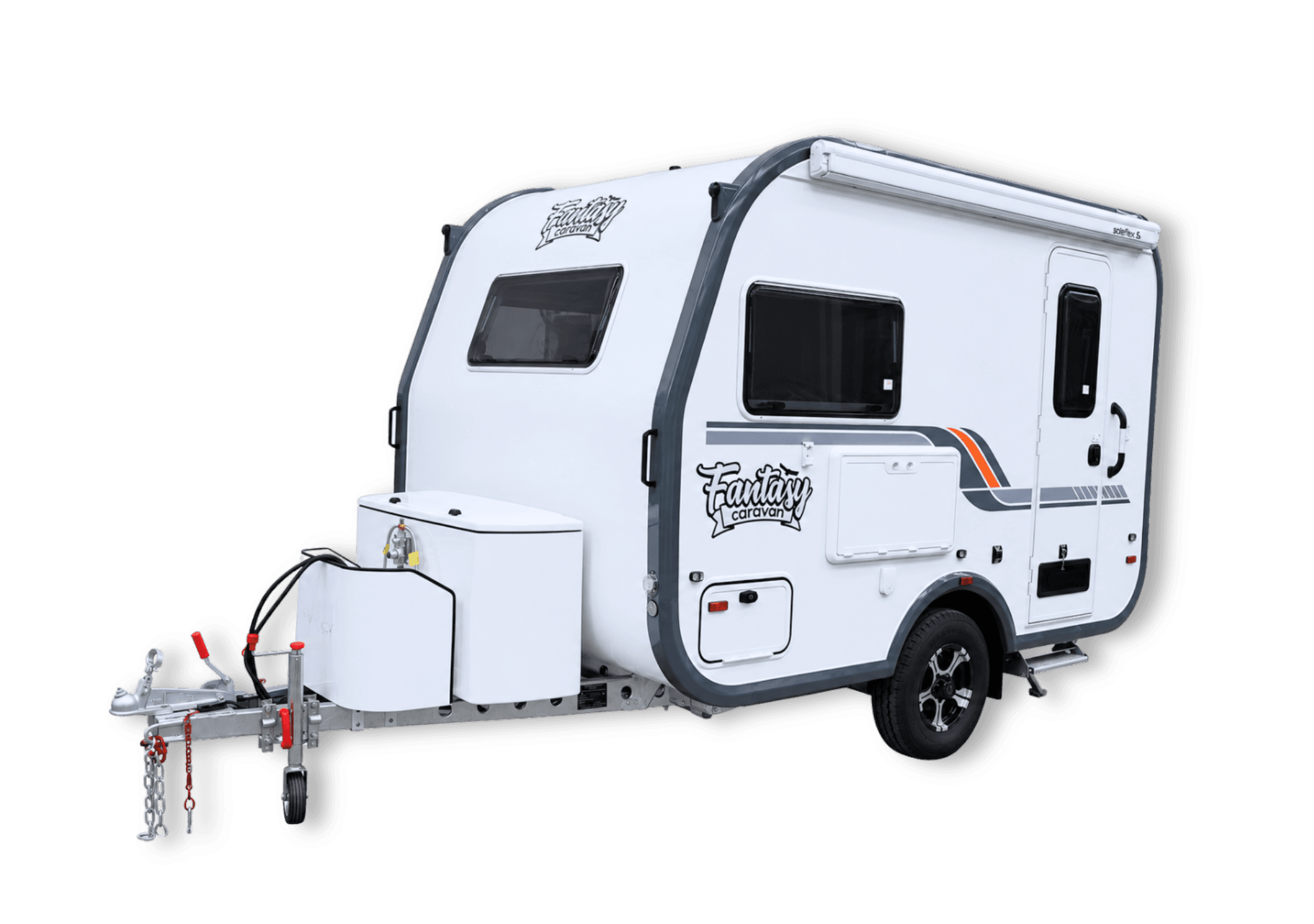
The lightest full-size caravans in the database are compact on-road tourers such as the Fantasy Mystic 11 (1,200 kg tare) and the Golf Maxxi 390 PT (1,350 kg tare). For more options at the light end, see our guide to the best small caravans under 1500kg.
ATM: the market is built around 3,000 and 3,500 kg tow ratings
ATM ratings cluster tightly around common tow vehicle limits. 3,500 kg is the most common single rating (48 models), followed by 3,000 kg (19 models). Together, the 2,501–3,000 kg and 3,001–3,500 kg bands hold 128 of 180 models (71.1%).
| ATM | Models | Share of 180 |
|---|---|---|
| 2,000 kg or less | 16 | 8.9% |
| 2,001–2,500 kg | 22 | 12.2% |
| 2,501–3,000 kg | 59 | 32.8% |
| 3,001–3,500 kg | 69 | 38.3% |
| Over 3,500 kg | 14 | 7.8% |
The 14 models rated above 3,500 kg sit beyond the 3,500 kg maximum braked towing capacity quoted for most dual-cab utes and large four-wheel drives sold in Australia. Our GVM upgrades guide explains why a tow rating alone does not settle whether a combination is legal, and what can my car tow? walks through the checks. If your vehicle is rated to 3,500 kg, see our shortlist of caravans for 3500kg towing capacity.
How Much Payload Does a Caravan Have?
Payload is the number most buyers never check and the one most likely to put a rig over its limits. Across the 167 models in The Caravan Database that publish both tare and ATM, the median payload is 675 kg. For the median van, payload is 21.9% of ATM.
| Payload | Models | Share of 167 |
|---|---|---|
| Under 400 kg | 5 | 3.0% |
| 400–499 kg | 11 | 6.6% |
| 500–599 kg | 27 | 16.2% |
| 600–799 kg | 78 | 46.7% |
| 800–999 kg | 34 | 20.4% |
| 1,000 kg or more | 12 | 7.2% |
One in four models (43 of 167, 25.7%) has less than 600 kg of payload. That allowance has to cover everything not fitted at the factory. Water alone weighs about 1 kg per litre, so filling the most common 190-litre fresh water setup uses about 190 kg of it before you load any gear.
At the top end, the Kedron TE7 Topender (1,460 kg), JB Caravans Scorpion Sting Air (1,455 kg) and Spinifex NomadiX Premier 20.6 (1,400 kg) carry at least twice the median payload. The JB and the Spinifex are rated to a 4,500 kg ATM, and the Kedron to 6,000 kg.
To check a specific van against a specific tow vehicle with real numbers, use our free rig loading simulator or the payload calculator.
How Much Does a Caravan Cost in Australia?
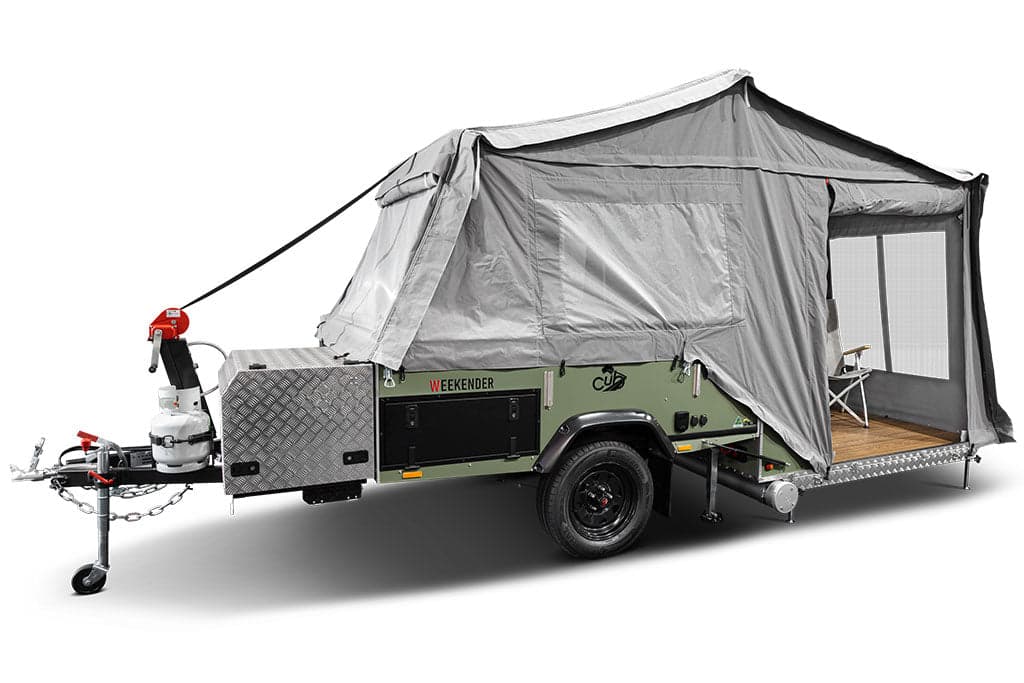
Across the 146 models in The Caravan Database with a listed price, the median new caravan costs $88,245. The middle half of the market sits between about $68,300 and $118,100. The cheapest priced model is the Cub Campers Weekender camper trailer at $23,990.
| Listed price | Models | Share of 146 |
|---|---|---|
| Under $60,000 | 19 | 13.0% |
| $60,000–$79,999 | 43 | 29.5% |
| $80,000–$99,999 | 33 | 22.6% |
| $100,000–$149,999 | 31 | 21.2% |
| $150,000 or more | 20 | 13.7% |
More of the market sits below the $80,000 to $100,000 band than above it: 62 models (42.5%) are listed under $80,000 and 51 (34.9%) at $100,000 or more. Price data covers just over half the catalogue (146 of 261 models), because many manufacturers only quote prices through dealers. If you are shopping under $80,000, our best caravans under $80,000 guide compares the options.
Price by type and style
| Category | Models | Priced (n) | Median price | Tare (n) | Median tare | Payload (n) | Median payload |
|---|---|---|---|---|---|---|---|
| All caravans (full van) | 203 | 95 | $94,490 | 131 | 2,470 kg | 116 | 650 kg |
| Off-road caravans | 119 | 62 | $102,490 | 68 | 2,670 kg | 60 | 700 kg |
| On-road caravans | 49 | 24 | $73,640 | 37 | 2,230 kg | 30 | 604 kg |
| All-terrain caravans | 24 | 7 | $87,990 | 16 | 2,393 kg | 16 | 700 kg |
| Hybrids | 47 | 41 | $78,990 | 43 | 2,250 kg | 41 | 700 kg |
| Camper trailers | 11 | 10 | $46,490 | 10 | 1,242 kg | 10 | 634 kg |
Off-road caravans are the priciest and heaviest style: a median of $102,490 and 2,670 kg tare, against $73,640 and 2,230 kg for on-road caravans. The on-road, all-terrain and camper trailer price medians rest on 24, 7 and 10 priced models respectively, so treat them as indicative rather than definitive.
Water, Battery and Solar
| Measure | Models (n) | Lowest | Median | Mean | Highest |
|---|---|---|---|---|---|
| Fresh water | 166 | 60 L | 190 L | 201 L | 440 L |
| Battery capacity | 187 | 100Ah | 300Ah | 363Ah | 1,300Ah |
| Solar | 168 | 150 W | 510 W | 612 W | 2,000 W |
| Grey water | 0 | — | — | — | — |
Water. 190 litres is both the median and the most common fresh water capacity (63 of 166 models), followed by 240 L (20 models) and 220 L (17 models). Only 10 models (6.0%) carry 300 litres or more, led by two Spinifex models, the NomadiX Premier 20.6 at 440 L and the NomadiX at 400 L, then the Supreme Base Camp X at 380 L.
Battery. The median van ships with 300Ah of battery capacity. Off-road caravans carry a median of 400Ah (88 models) against 135Ah for on-road caravans (30 models). About one in four models (47 of 187, 25.1%) has 600Ah or more.
Solar. The median van has 510 W of solar, and 50 of 168 models (29.8%) have 800 W or more. Off-road caravans have a median of 688 W (76 models) against 400 W for on-road caravans (36 models).
For vans built around long stays away from power, see our best off-grid caravans ranking, which is built on the same water, payload and electrical data.
Size
Across the 175 models with a published length, the median caravan is 6.80 m long, and lengths run from 3.73 m to 9.50 m. Widths (145 models) have a median of 2.39 m, close to the 2.5 m legal limit. Our caravan dimensions guide covers width, length, height and the legal limits in detail.
Where Australian Caravans Are Built
Origin is the specification manufacturers are least likely to state plainly. The Caravan Database records a brand as built in Australia, or not, only when a cited source supports it. Every other brand stays "unverified" rather than being guessed.
| Brand origin status | Brands | Share of 61 brands | Published models | Share of 261 models |
|---|---|---|---|---|
| Verified built in Australia | 9 | 14.8% | 39 | 14.9% |
| Verified imported or import-assembled | 6 | 9.8% | 43 | 16.5% |
| Not yet verified | 46 | 75.4% | 179 | 68.6% |
The nine brands with a cited, verified Australian-built status are Bushtracker, Cub Campers, Evernew, Jayco, Kedron, Lotus, Millard, New Age and Zone RV. A further 12 models carry model-level chassis, shell and fit-out origin flags: 11 Cub Campers models backed by a cited source, and one Concept Caravans model (the Innovation RS Off Road 605) attested by the manufacturer.
"Not yet verified" does not mean imported. It means we have not found a source we are prepared to cite. Our best Australian-made caravans guide lists the verified brands, and what "Made in Australia" actually means explains the legal difference between made, assembled and designed here. Brand stability is a separate question again; see caravan brands to avoid for documented company collapses.
A Spread-Out Market
No single brand dominates the catalogue. The 261 published models come from 61 brands. The largest, Austrack Campers, has 23 published models (8.8%), and the median brand has 4. Eight brands have a single published model. You can see every brand in our A to Z of caravan manufacturers.
Frequently Asked Questions
What is the average weight of a caravan in Australia?
According to The Caravan Database, the median Australian caravan has a tare (empty) weight of 2,335 kg and an ATM (maximum loaded weight) of 3,000 kg. The mean tare is 2,325 kg across 184 models and the mean ATM is 3,053 kg across 180 models.
How much payload does a typical caravan have?
The median payload is 675 kg across 167 models with both tare and ATM published. Half of all models fall between 591 kg and 800 kg, and 9.6% have less than 500 kg.
How much does a new caravan cost in Australia?
The median listed price is $88,245 across 146 priced models. Off-road caravans have a median price of $102,490 (62 priced models), and hybrids $78,990 (41 priced models).
How much water does a caravan hold?
The median and most common fresh water capacity is 190 litres, across 166 models with a published capacity.
Methodology
- Source. The Caravan Database's caravans table, which records manufacturer-published specifications for new caravans sold in Australia. Figures are the manufacturer's stated specifications. They are not independently weighed or measured.
- Snapshot date. 27 October 2026. The database changes as manufacturers add models and correct specifications, so later figures will differ.
- What is counted. Every caravan, hybrid and camper trailer listing that is published on the site: 261 models from 61 brands. 250 are 2026 models, 3 are 2027 models and 8 are 2024 or 2025 models still listed. Draft listings and internal test records are excluded. Each model is counted once, regardless of how many layouts or options it is sold in.
- Sample sizes. Each figure is calculated only over models that publish that specification, and the number of models (n) is shown with every figure. Coverage: tare 184, ATM 180, payload 167, length 175, width 145, price 146, fresh water 166, battery 187, solar 168.
- Payload is calculated as ATM minus tare, for models that publish both figures.
- Prices are as recorded on each listing at the snapshot date. They are not adjusted for options, on-road costs or dealer discounts.
- Battery capacity is in amp-hours (Ah). Where a maker quotes a 24 V system, the listing records the 12 V-equivalent capacity the maker states. For example, the EzyTrail Parkes 14R Twin MK4 is listed at 940Ah, which EzyTrail states as the 12.8 V equivalent of its two 24 V 235Ah batteries.
- Style categories (off-road, on-road, all-terrain) follow the manufacturer's own classification. 12 models have no style recorded.
- Rounding. Where a median or quartile falls between two models, it is the midpoint of the two, rounded to the nearest whole unit. Means are rounded to the nearest whole unit. Percentages are rounded to one decimal place.
- Excluded for low coverage. Towball mass (16 models), GTM (20 models) and grey water capacity (0 models) are published too rarely to report.
- Independence. No manufacturer pays to appear in, or to influence, these statistics.
Suggested citation: Source: The Caravan Database, October 2026 (thecaravandatabase.com/articles/australian-caravan-statistics).
Explore the Data Yourself
Every number above comes from listings you can open. Browse all published caravans, filter by weight, price or water, and compare models side by side. Where a manufacturer has not published a specification, the listing shows an em dash rather than a guess.